




















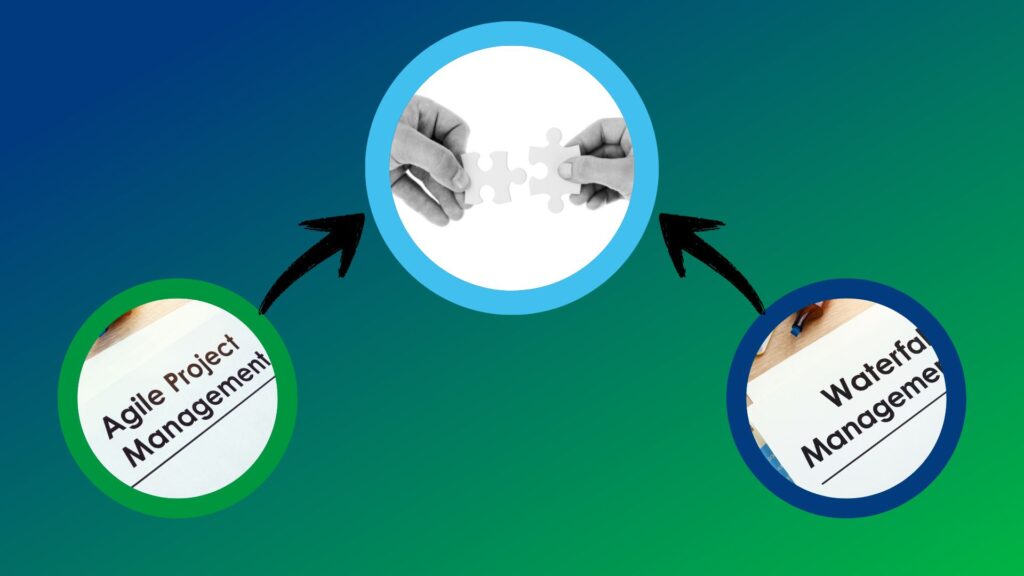
When a large bank decided to revamp its ERP system, the project team faced a dilemma. On the one hand, interfacing with existing systems and compliance requirements required tight planning and documentation (waterfall). On the other hand, management and users wanted quick input on functionalities and usability (agile). The solution? A hybrid project approach. By combining fixed milestones with iterative sprints, the team was able to both comply with regulations and respond to user feedback.
This example is not an isolated one. Thanks to recent insights from the PMI Pulse of the Profession 2024-research is clear that hybrid project management methodologies are booming. According to this research, about a third of organisations now use a hybrid project management approach, with adoption rising from 20% in 2020 to 31.5% in 2023. The trend is clear: organisations are looking for flexibility without losing control. This trend is confirmed by other sources such as Gartner and Half Double, which point to the need to combine traditional and agile methods to better address the complexity of modern projects; fit-for-purpose.
Hybrid Project Management: The Best of Two Worlds
Hybrid project management combines the predictability and structure of traditional (waterfall) methods with the agility and iterative approach of agile frameworks. This combination offers organisations the flexibility to tailor their approach to the nature of the project, the stakeholders involved and the level of uncertainty. The methods reinforce each other on several topics:
-
Phasing and flexibility
Hybrid forms of work combine certainty and flexibility by combining the predictability of milestone planning with the agility of Kanban boards or Scrum boards. In traditional project management environments, detailed planning provides overview and grip for management, while agile teams prioritise and plan their work with visual tools. Communicating milestones in outline form and organising team-level activities flexibly creates a hybrid approach that both ensures compliance and encourages innovation. This allows processes with fixed milestones, such as regulatory processes, to merge smoothly with iterative experimentation in sprints, for example in product developments in the pharmaceutical sector. This creates an effective combination of structure and agility, allowing all stakeholders to perform their work optimally within clear frameworks.
-
Control and Responsiveness
A hybrid approach ensures that stakeholders feel heard as well as keeping the project within time and budget. Large IT implementations, such as ERP systems, involve a huge number of stakeholders with varying requirements. A traditional Waterfall approach provides structure here via a detailed project plan, business case and thorough scope management. This gives the organisation's management a certain degree of certainty for a substantial investment. In the same project, Agile adds value through continuous prioritisation of required functionalities based on current needs and regular demos with users.
-
Risk management and speed
By combining waterfall and agile methods, organisations can quickly deliver value as well as manage risks. Digital transformation projects require speed, but also involve significant risks. A traditional Waterfall approach helps identify and manage risks by setting up and following a thorough process. Agile accelerates delivery through rapid iterations, being able to quickly process user feedback and launching Minimum Viable Products (MVPs).
Hybrid Project Management: Not Without Risks
Hybrid project management offers many advantages, but also has risks:
Role clarity
In a hybrid approach, roles from agile (Scrum Master, Product Owner) and traditional project manager (Project Manager, Steering Committee) can get mixed up. This can lead to confusion over responsibilities: Who decides on scope changes? Who monitors the schedule?
For example, in an IT project where both a Product Owner and a project manager are active, it may be unclear who sets priorities when there are conflicting interests. It is therefore important to establish clear governance in good time that explicitly defines roles and decision-making.
Planning horizon
Agile works iteratively and quickly, while waterfall often works with longer planning cycles. This difference in rhythm and planning can lead to frustration among stakeholders, who are used to fixed delivery times.
For example, an agile team delivers an MVP, but the waterfall team does not yet have the deployment plan ready, delaying implementation. Setting up a joint roadmap that aligns iterative deliverables with fixed deadlines can then provide relief.
Suboptimal choices
If the hybrid approach is not properly designed, there is a risk of combining the worst of both worlds.
For example, a project that is driven by the delivery of documentation AND lacks flexibility. Or project team has to comply with extensive planning documentation, but is not allowed to make changes without formal approval. So it is essential to consciously choose which elements of agile and waterfall are applied, and why.
Hybrid is not a compromise, but a strategy
The rise of hybrid project management is not a temporary trend, but a strategic response to the complexity of today's projects. Organisations that embrace hybrid methods are better able to navigate between stability and flexibility, between control and innovation. But one size does not fit all; the hybrid approach is different for each organisation. The right set-up depends on project type, complexity, client needs and team maturity.
Many teams are either trained in agile or in traditional project management. Hybrid working requires new skills and mindset. A team used to agile sprints may struggle to deliver according to the deadlines in a Gantt schedule. It is therefore essential to devote sufficient time to training and mentoring, e.g. through coaching on the job.
Want to know how your organisation can successfully apply hybrid project management? Or are you curious about how to train your team in hybrid skills? Contact us and together we will bring structure and agility to your projects.

 Services
 Your career
 About us
 Social impact
 Contact
 News
News