






















From ‘surely this can be done faster’ to up to 33% shorter lead time at a large government organisation through a Kaizen approach. Wondering how we went about it? In this article, I take you step by step through our improvement process.
What is a Kaizen?
Kaizen is a systematic method of improving processes step by step through small, achievable adjustments. Instead of large, costly, change projects, Kaizen focuses on eliminating waste and inefficiency by the people who actually do the work. The beauty of Kaizen is that everyone can participate - from employees to managers - and you often see concrete results within just a few days.
A Kaizen consists of the successive 6 steps.
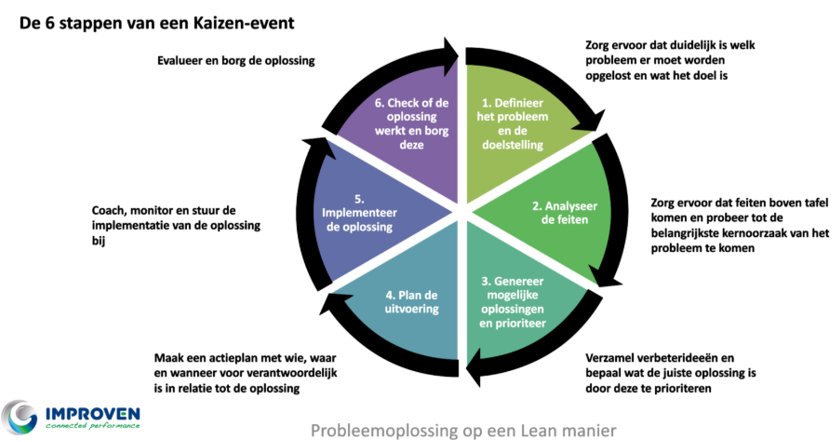
Figure 1: The 6 steps of a Kaizen
Step 1: Problem definition
The first step involves defining the problem and setting the objective.
The team carries out various activities, including the so-called data check. In this process, the team receives data from the citizen. Using the internal system, the team checks whether the data is correct and then feedback this to the citizen through a feedback document. The feedback document indicates whether the data was correct or incorrect. If the citizen shared incorrect data, the team must note the correct data in the feedback document. This process step is currently carried out by two different staff members.
For this Kaizen, we selected a process step that turned out to be crucial for turnaround time: data check feedback. During the analysis, we saw that this step was relatively time-consuming due to manual and sometimes duplicate actions according to the official work instructions. This not only caused delays but also additional workload. The team was convinced that this could be done smarter and faster.
After joint consultation and bottleneck mapping, we formulated the following problem statement: “How do we ensure that the data check feedback process can be faster?”
Step 2: Analyse the facts
After formulating the problem statement, it is important to look at facts first and not come up with solutions right away. Coming up with immediate solutions often solves only the visible problem, not the root cause. This leads to temporary improvements and the problem returns. By identifying the root cause first, you tackle the problem structurally.
An effective method to get to the root cause is the “5x Why method”, as explained earlier in colleague Pim van Dommelen's article: What problem are we actually solving with this? - Improven. This step is often seen as the most complicated, as people are naturally inclined to come up with immediate solutions when problems arise. Finding the root cause therefore also proved to be a challenge for the team, but with the help of this method, they finally succeeded!
We used an Ishikawa diagram (see Figure 2) to systematically map all possible causes. This fishbone diagram helps not to overlook anything by organising causes into fixed categories.
Finally, we measured the turnaround time per file to get a good picture of the as-is situation. We need this processing time in a later step, in order to determine whether the implemented solutions have actually had an effect.
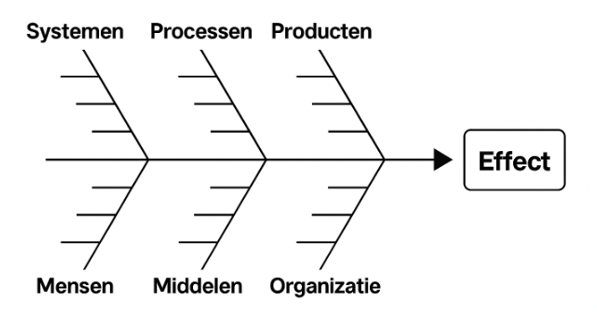
Figure 2: Ishikawa diagram
Step 3: Generate solutions
After analysing the root cause and measuring the turnaround time for each case, we set to work generating solutions. In this step, the team has to come up with as many and as creative solutions as possible that solve the root cause of the problem. In this step, you do not yet decide which solution will be chosen. It is about looking at all possibilities. So this step comes after the analysis of the problem, so that you can come up with solutions that solve the real cause of the problem.
In total, the team came up with 13 different solutions to address the problem. After collecting these 13 ideas, they were evaluated according to a priority matrix.
An Impact Ease Matrix is used to visualise which solutions deliver the most gains in the shortest time. You plot each solution at a place in this matrix where the degree of ease of implementation (low to high) and the degree of impact (low to high) are determined. There are four quadrants in this matrix. Each solution thus falls into one of the four quadrants. Figure 3 shows the completed Impact ease matrix of this Kaizen.
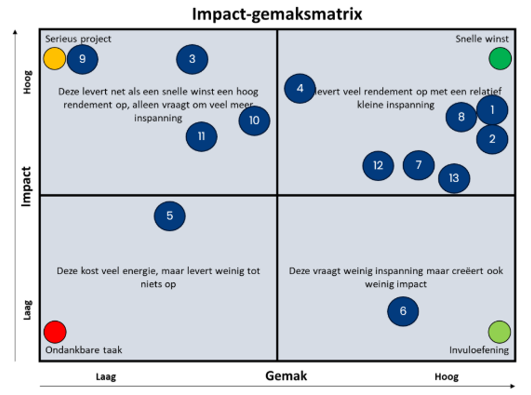
Figure 3: Impact convenience matrix
|
Solution # |
What is the solution? |
Expected impact? |
|
1 |
No more filling in unused information in the business system |
This information must currently be entered into the business system. However, nothing is done with this information in the whole process. The team unnecessarily processes information which takes time. |
|
2 |
Modify the template of the feedback document so that standard answers can be selected and no longer need to be typed out.
|
There are some standard answers that need to be filled in the template. Currently, these answers must always be typed out. With this solution, the team can easily select the answer and it does not have to be typed out every time. This can save a lot of time. |
|
8 |
Adjust the templates of available documents so as to go from three to two documents to be opened per file. |
To create the feedback document, the team has to extract the information from three different documents. Some required information is in all three documents. The team wants to modify the templates of two documents so that all the information can be found in two documents instead of three, thus eliminating the need to open the third. This is expected to save time. |
Table 1: Chosen solutions explained
The remaining 10 solutions were not implemented in this Kaizen because it was expected that the three selected solutions would already have a lot of impact in solving the problem. In addition, most of the other possible solutions would not be as easy to implement, but the team will definitely keep them under consideration for follow-up projects.
Step 5: Implement the solution
In the fifth step, the solution is actually implemented. As indicated earlier, three solutions have been chosen in this Kaizen. These solutions are not implemented simultaneously, but individually from each other. After each implementation of a solution, the new lead time was measured again. This is because it is important to be able to see which solution actually had an impact and which did not.
In any implementation, it is important that the actions required before implementation have been carried out by those responsible. Good communication also plays a very important role in this.
Step 6: Evaluate and secure
In the final step, the solutions are evaluated and the desired solutions are secured in the process.
Once all the solutions had been implemented and the new turnaround times measured, it was time to analyse the results. The final result exceeded all expectations. The results showed that after implementing all three solutions, the average processing time per file had decreased. Staff member 1 handled a case 17.4% faster on average. Staff member 2 handled a case even 33.3% faster on average.
As indicated earlier, the impact of all individual solutions must also be considered. Solution 2 was found to have the greatest impact on the lead time of the process. The other two solutions (solutions 1 and 8) had a relatively smaller impact on lead time.
Table 2 shows the results for each solution, with insights into how much percent faster the solution was compared to the as-is situation and compared to the previous implementation of a solution.
|
|
Faster compared to as-is
Employee 1 |
Faster compared to as-is situation
Employee 2 |
Faster compared to previous implementation
Employee 1 |
Faster compared to previous implementation
Employee 2 |
|
Solution 1 |
3,3% |
2,9% |
– |
– |
|
Solution 2 |
14,0% |
31,9% |
11,1% |
29,9% |
|
Solution 8 |
17,4% |
33,3% |
3,8% |
2,1% |
Table 2: Percentage of time saved per solution and employee
The team was very satisfied with the result and noticed in practice that the new way of working is more pleasant and faster. Despite the fact that solutions 1 and 8 did not have a lesser impact on turnaround time compared to solution 2, the team still decided to implement these solutions as well, as it makes work more pleasant.
The biggest gain: a different mindset. The team enjoyed doing a Kaizen and this made them realise that there is often much more room for improvement than previously thought. This Kaizen helped them to look at processes much more critically.
In addition, all work instructions for this process have been updated so that this has become the new way of working. The entire team was trained on the process changes. The other stakeholder indirectly affected by the process were informed whenever a change was required from the team.
Discover the improvement potential in your organisation!
This Kaizen shows that improvement does not have to be complex. Three relatively simple adjustments resulted in time savings of up to 33% - and that is only the beginning. The team now looks at their work differently: where before they thought “this is the way it should be”, they now see opportunities for improvement. That mindset shift is perhaps the biggest gain of all.
Do you recognise this? Processes that everyone knows can be faster, but no one takes the time to really address? Then start your own Kaizen or contact Tess Vercammen for a no-obligation discussion. At Improven, we like to help teams discover the hidden improvement opportunities in their daily work.

 Services
 Career
 About us
 Contact