






















In a rapidly changing world, adaptability is becoming crucial for both people and organisations. This places increasingly high demands on the way changes are organised. As a result, there is a growing need for portfolio, programme and project leaders as well as strong PMO professionals who give direction, connect and help realise agility.
Each year, IMPROVEN produces an overview of key trends and developments in the field of project & portfolio management based on experiences at various organisations across the Netherlands.
1. AI in PM is becoming more concrete
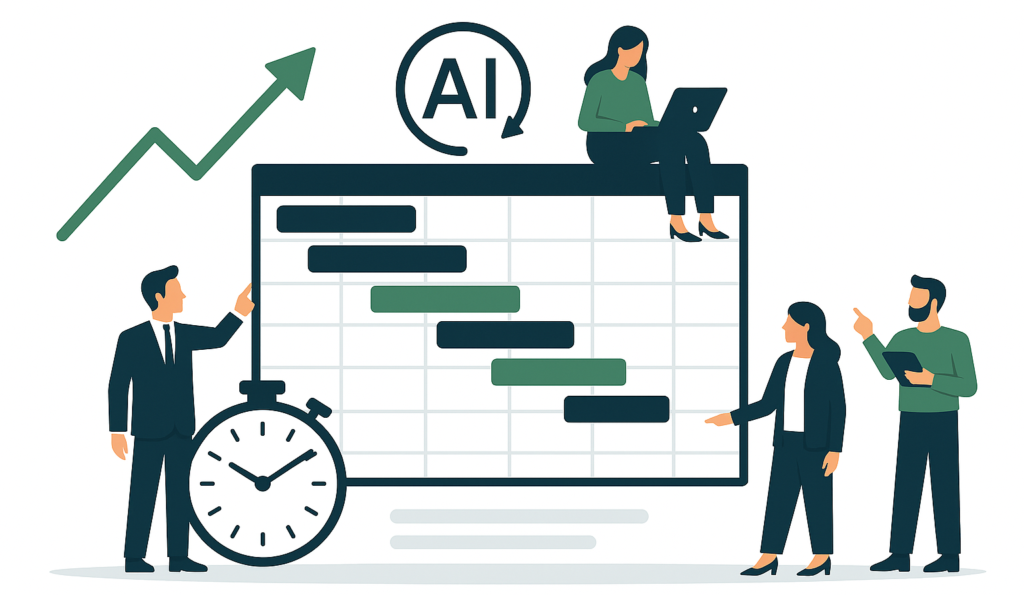
Artificial Intelligence (AI) is undoubtedly the dominant development in project management. Although the hype is waning slightly and criticism is growing, AI is becoming more practical; we are beginning to understand what we can do with it. Organisations are increasingly using the technology to execute projects smarter, faster and more consistently. New PM tools automatically generate risk analyses, stakeholder analyses and schedules. This can deliver great value, but also carries risks. AI models rely on historical data and assumptions, can amplify bias and are trusted too quickly. Without critical review by the project team, errors or overestimates can go unnoticed. In addition, support for AI-generated plans is lower, putting pressure on ownership and the likelihood of success. This is precisely why it remains essential that analyses and planning are done together with stakeholders. Our colleague Michel Hoeijmans has previously written an article on trends in AI, which can be found on our website.
2. Shift in the PM tool landscape
That acceleration in practical applicability will gain additional momentum as Microsoft discontinues Project Online on 30 September 2026, forcing many organisations (forced) to migrate to modern alternatives that rely heavily on AI and integration with Microsoft 365. As a result, the PM tool market is shifting towards platforms where flexibility, Teams integration, the Power Platform and built-in AI functionality are becoming the norm. But there are also developments in the other direction; by using Microsoft's Power Platform properly, organisations are able to build their own approachable custom PM tools that fit how they manage their projects and portfolio.

3. Situational project leadership: from directing to inspiring
The massive use of AI is changing the role of project managers. The focus shifts from planning and reporting (the upper stream), to motivating and connecting people, creating and propagating a shared vision and giving direction in uncertain circumstances (the lower stream). Situational leadership thus becomes a crucial skill: the modern project leader must be able to switch effectively between different leadership styles, attuned to the individual needs of team members and the phase the project is in. The project leader is thus increasingly developing into a change leader: someone who not only controls results, but also knows how to manage behaviour, expectations and resistance during the change.
4. Gen Z on project teams
The changed role of the project leader is partly fuelled by the influx of a new generation of team members: Gen Z. This generation attaches much greater importance to meaningful work, personal growth and a clear contribution to social or organisational goals. Project leaders who are able to recognise these values and give team members space not only increase commitment but also ownership within the team. This makes situational project leadership a foundation for sustainable project results and resilient teams in a continuously changing environment. Gen Z. looks very differently at a work-life balance and working in the office than more traditional project leaders; this too will require a change in leadership capabilities and ways of working.

5. Adaptive hybrid project management
Hybrid project management, combining waterfall and agile elements, continues to evolve rapidly in response to the complexity of modern organisations. The latest trend is the shift from a static mix of agile and traditional methodologies to an adaptive hybrid approach, where teams dynamically switch between standards depending on project phase, risk profile and stakeholder needs. We see a strong focus on governance, capabilities and culture: organisations are investing in developing a common language, employee skills and mindset so that hybrid working is not just a process choice, but gives a strategic advantage. We also see that the hard divide between project management (delivery) and change management (adoption) is disappearing. We expect a methodology to be hybrid in 2026 only if it not only combines Agile and Waterfall, but also integrates change management activities into the project lifecycle from day one. Our colleague Maarten van Weeghel has previously written an article on this, which can be found on our website.
6. Centralising portfolios
The initial impetus for portfolio management generally arises organically in a department (usually IT). Each department then builds its own modus operandi, processes and reporting structures. As portfolio management continues to grow and add visible value, the need arises to centralise and professionalise the fragmented approach. Organisations want to move towards one uniform way of steering, prioritising and reporting; from sub-optimal to optimal. The thinking behind this is logical: if portfolio management works well in one department, why not translate it to the entire organisation? But centralisation also raises new questions. How do you deal with sub-portfolios that are very different from each other? Do they follow full central frameworks, or do they only report on outlines to the ‘higher army leadership’? Successful centralisation therefore requires clear governance, clear rules of the game and room to allow sub-portfolios to retain some autonomy. Only then will a powerful, coherent portfolio management system emerge that works organisation-wide and enables the organisation to make the right choices and achieve its objectives.

7. Less is more in portfolio management
With rising costs, increasing complexity and limited capacity, organisations are forced to choose much more consciously what they do and do not do. Less is more thus becomes a strategic principle. Instead of one static annual portfolio, organisations are shifting to a ‘rolling strategy’: a continuous process of reassessing, prioritising and adjusting based on new insights. This results in a shorter strategic horizon; from 12 months to 6 or even 3 months. Thus, the classic portfolio evolves into a rolling portfolio: a portfolio that moves flexibly with changing circumstances and is no longer filled with everything that is possible, but with what really adds value.
8. Sustainability: from project to KPI
Whereas ESG and sustainability initiatives still dominated a significant part of portfolios in 2024, mainly driven by laws and regulations, we already saw a shift in 2025; the amount of explicit ESG projects is decreasing. But this does not mean that sustainability is out of the picture. On the contrary: it is no longer a separate strategic theme, but fully integrated into the consideration framework of new initiatives, alongside, for instance, cost, speed, risk and strategic value. Sustainability thus becomes less a mandatory number and more a quality criterion, similar to security-by-design or privacy-by-default. This creates a more mature way of steering: sustainability is included where it adds value, without blocking portfolio capacity. The result is a more realistic, better-balanced portfolio where sustainability is part of the norm, not the exception, and precisely because of this it is better embedded in decision-making.
9. From PMO to SEO
Organisations need more from the central PMO than just process support. The Strategy Execution Office or SEO forms the link between strategy and execution: it links organisational goals to projects and programmes, drives value, lead times, benefits and risks, and secures fast, data-driven decision-making. By monitoring priorities, managing dependencies and allocating resources efficiently and effectively, the SEO increases realisation power and predictability. This delivers concrete value: better investment choices, higher ROI, shorter time-to-value and fewer escalations thanks to transparent information flows and light, effective governance. The SEO is thus emphatically not a project police, but a strategic partner that improves the performance of the total portfolio and converts strategy into measurable results. This shifts the focus from ‘control for control's sake’ to value streams, throughput and benefits realisation. Our colleagues Paul Vervoort and Robbert Vermeire have written an interesting article on strategy execution, which can be found on our website.
10. Split between ‘Build PMO’ and ‘Deployment PMO’
In large complex transformations where the technical realisation of capabilities and organisational adoption are far apart, as in digitalisation programmes, for example, we increasingly see a separation between build support on the one hand and implementation support on the other. The ‘Build PMO’ focuses on the successful realisation of the technical solutions: planning, dependencies, resource allocation and quality assurance within the development processes, often along the lines of SCRUM and SAFe. In contrast, the ‘Implementation PMO’ focuses on deployment, adoption and managing impact on the organisation, using models such as ADKAR and Prosci. This split arises because competences, governance and KPIs are fundamentally different in the two phases. Whereas the Build PMO primarily manages delivery and technical milestones, the Deployment PMO focuses on change management and user acceptance. Together, they create value. This requires close coordination, but also a clear division of roles to avoid friction and delay.

The world of projects, programmes and portfolios continues to evolve. Organisations that want to remain agile need to invest not only in methodologies and technology, but especially in collaboration, leadership and the ability to learn continuously. Today's trends are not an end point, but an invitation to look ahead and build sustainable value together.
 Services
 Career
 About us
 Contact