




















 EN
EN  NL
NL 
In an earlier article ‘How with AI, four process domains are merging into one intelligent ecosystem’ we described how AI brings strategy, control, execution and optimisation ever closer together. That article in particular showed what changes: process management is evolving from separate domains to a learning entity in which people and technology work together.
But such an ecosystem does not emerge overnight.
In this follow-up article, we look at the development towards it. How does cohesion between process domains actually grow? Which intermediate steps can be recognised in it? And what role does AI play at each stage - realistically, without overestimating?
Not as a technology story, but as development path for mature organising.
Not a leap, but a growth path
AI rarely turns out to be the starting point of change. Rather, it is a accelerator of what is already in place. Organisations find that the value of AI is strongly related to how mature processes, information and control are set up.
The extent to which AI can actually contribute is determined by:
- How explicit processes are set up,
- how coherently information is managed,
- How decision-making is organised,
- How feedback flows between domains.
Therefore, the ecosystem does not develop linearly, but through levels and phases. Each level has a recognisable pattern of collaboration between process domains - and a matching role for AI.
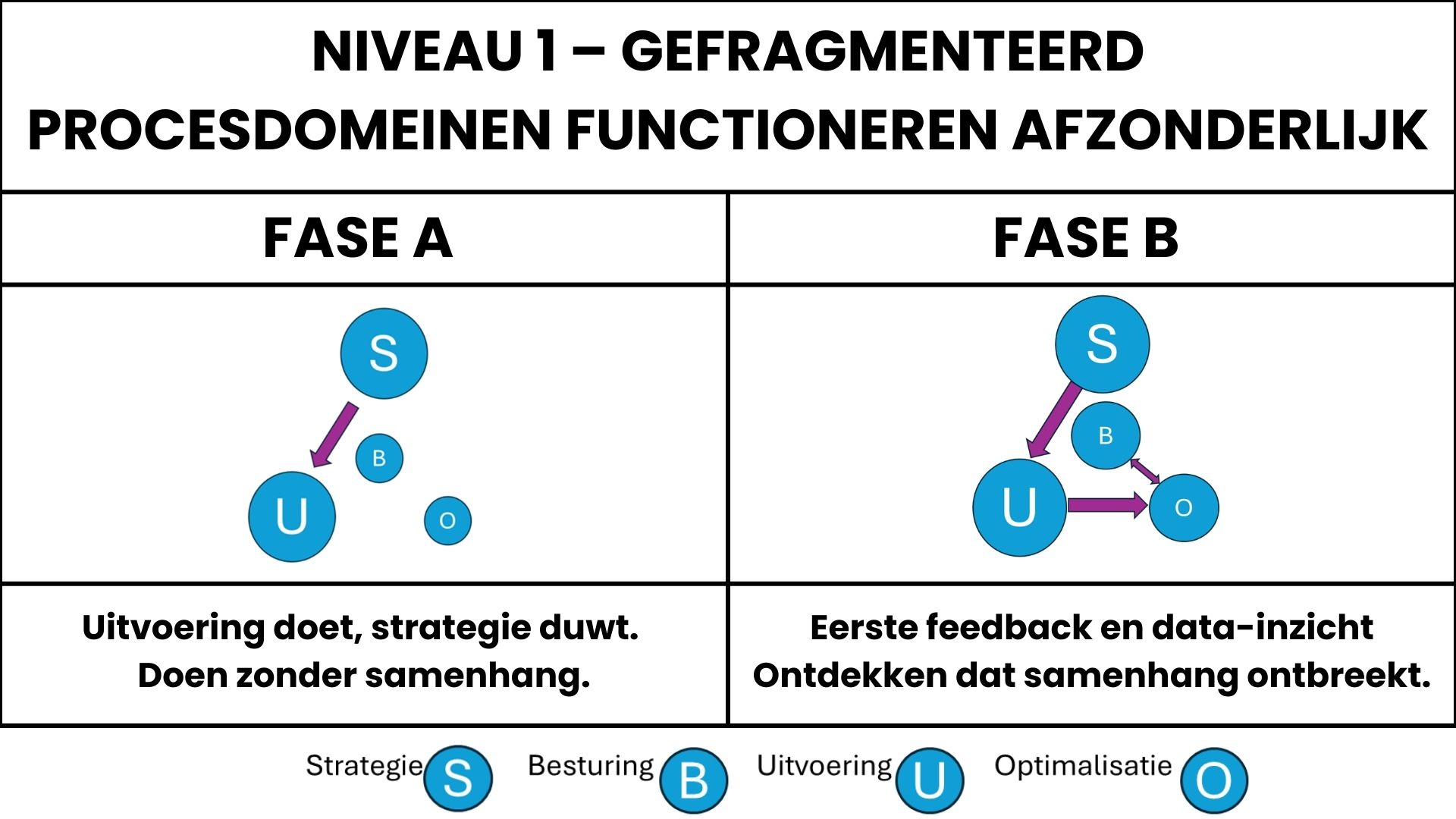
Level 1 - Fragmented
Process domains exist but operate independently of each other
In this starting point, strategy, control, execution and optimisation largely function as separate worlds. Processes are implicit and highly person-dependent. Much knowledge is in heads and routines, not in explicit agreements or structures. The organisation is mainly concerned with reacting to what presents itself.
Phase 1A - Strategy pushes, execution responds
Strategy sets direction in broad terms, but receives hardly any structural feedback from implementation. Decisions are often based on experience and intuition. Executive teams solve problems as soon as they become visible, without a view on wider effects or causes.
Optimisation occurs only in incidents: when something goes wrong, it is solved - often locally and temporarily. Information is fragmented and mainly available in hindsight. AI plays a role here at most in personal productivity, for instance in writing texts or analysing individual data sets.
Features
- Strategy: guiding, but hardly fuelled by implementation
- Governance: informal and incidental
- Implementation: ad hoc and person-dependent
- Optimisation: reactive and incident-driven
- Information provision: fragmented and retrospective
- AI role: individual, not process
Core mechanism: do without consistency
Phase 1B - First insight emerges
In this phase, awareness arises. Data is collected and dashboards appear. For the first time, patterns become visible: recurring disruptions, structural delays or quality problems. At the same time, consistency is lacking: data are separate from processes and require a lot of interpretation.
People see that processes influence each other, but still have limited ability to manage them. Improvements remain local and temporary. AI can support here with analysis, but lacks context and scope for action.
Features
- Strategy: receives first signals from operation
- Steering: gets limited visibility through reports
- Implementation: remains largely ad hoc
- Optimisation: identifies bottlenecks without structural assurance
- Information provision: patchy and not integrated
- AI role: analytical, incidental
Core mechanism: awareness of missing links
Level 2 - Structured
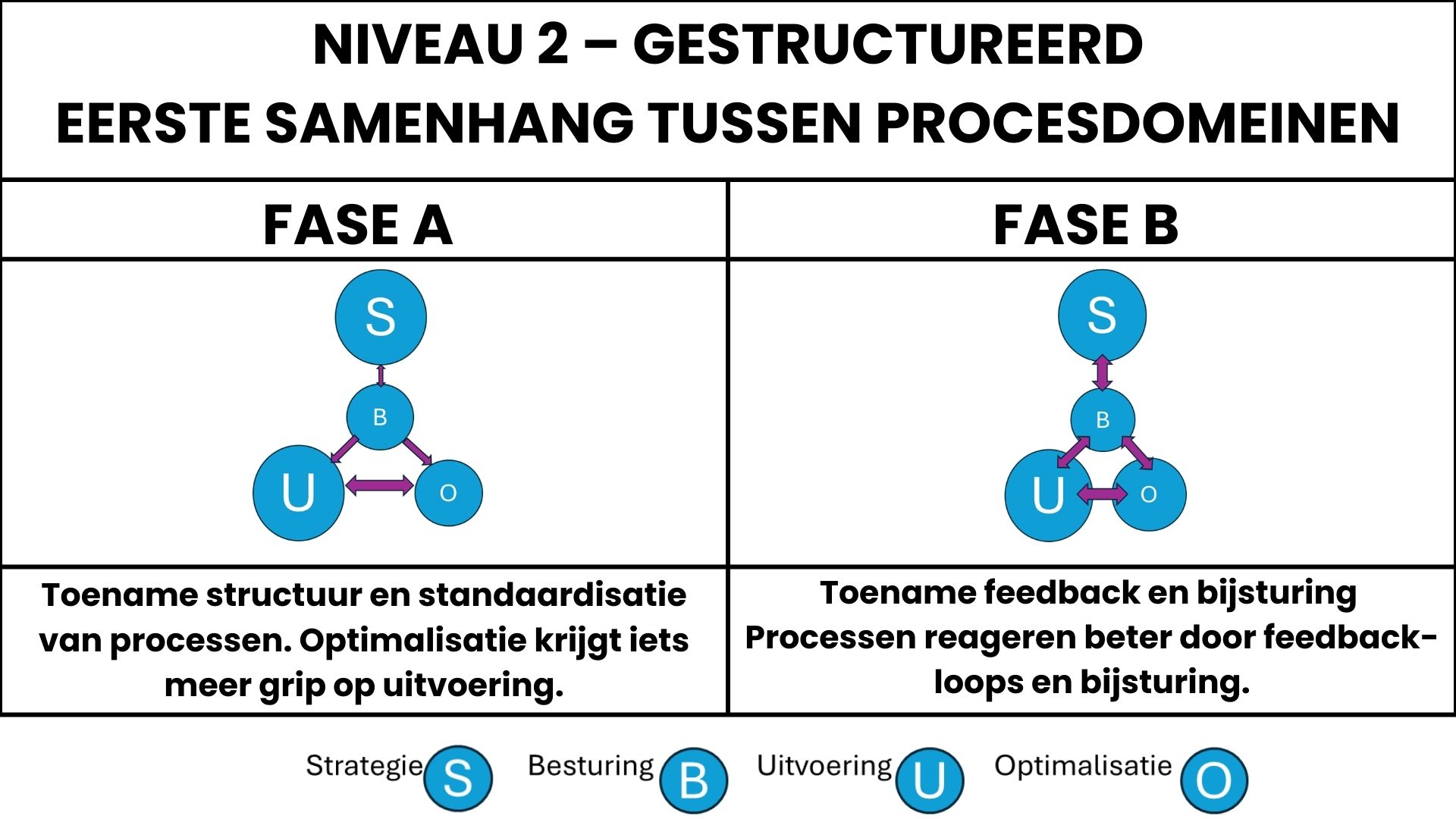
Coherence arises through structure and agreements
In this level, processes are explicitly designed and executed repeatably. Roles, responsibilities and definitions are established. Information management introduces frameworks, allowing information to be captured and shared more consistently. Process domains are still distinct, but no longer separate.
Phase 2A - Standardisation and control
The organisation gets a grip. Reports are reliable and form the basis for periodic steering. Deviations become visible and negotiable. AI supports analysis and automation, but decision-making remains emphatically human.
The focus is on stability: predictability, mastery and control.
Features
- Strategy: receive consistent steering information
- Steering: fixed dashboards and consultation moments
- Implementation: standardised and predictable
- Optimisation: identifies anomalies
- Information provision: central and reliable
- AI role: analytical and supportive
Core mechanism: stabilise and manage
Phase 2B - Leveraging feedback
Data is used more actively. Patterns lead to targeted improvement actions. Teams learn from previous results and adjust processes. Strategy periodically reviews and adjusts based on trends rather than incidents.
Coherence is now structural, but still mainly cyclic: learning and adjustment happens in fixed rhythms.
Features
- Strategy: steers by trends
- Control: more data-driven and dynamic
- Implementation: responds faster to insights
- Optimisation: cyclical and structural
- Information provision: shared and integrated
- AI role: predictive and advisory
Core mechanism: exploiting feedback within structure
Level 3 - Integrated
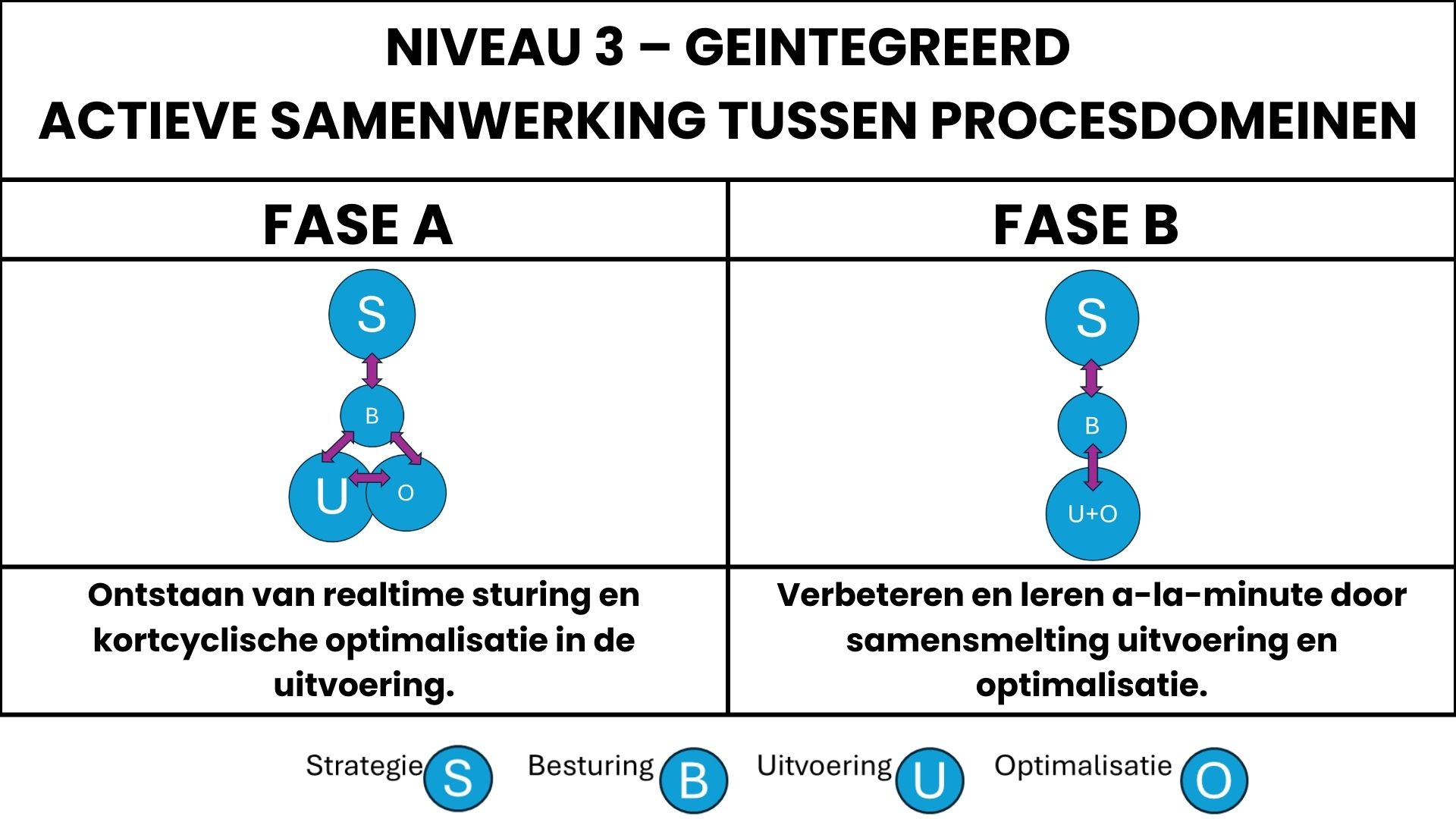
Cooperation during process execution
In this level, the boundaries between steering, execution and improvement blur. Decision-making shifts from periodic to continuous. Information is up-to-date and integrated, allowing processes to be adjusted during execution.
Phase 3A - Real-time adjustment
Processes are actively monitored and adjusted as they run. AI acts as a co-pilot interpreting real-time signals and making adjustment suggestions. People monitor frameworks and make choices.
Optimisation is no longer a separate activity, but part of the process itself.
Features
- Strategy: receive frequent feedback
- Control: continuous and adaptive
- Implementation: adjusted in real time
- Optimisation: integrated into execution
- Information provision: real-time and coherent
- AI role: co-pilot
Core mechanism: adjust while the process is running
Phase 3B - Learning and forecasting
Processes learn structurally from data. AI recognises patterns over time and initiates improvements within agreed frameworks. The organisation shifts from reacting to anticipating.
Strategy becomes forward-looking: scenarios and forecasts form the basis for choices.
Features
- Strategy: agile and predictive
- Control: scenario-driven
- Implementation: partly autonomously adapted
- Optimisation: continuous and cyclical
- Information provision: self-learning
- AI role: initiating and partly autonomous
Core mechanism: structural learning and anticipation
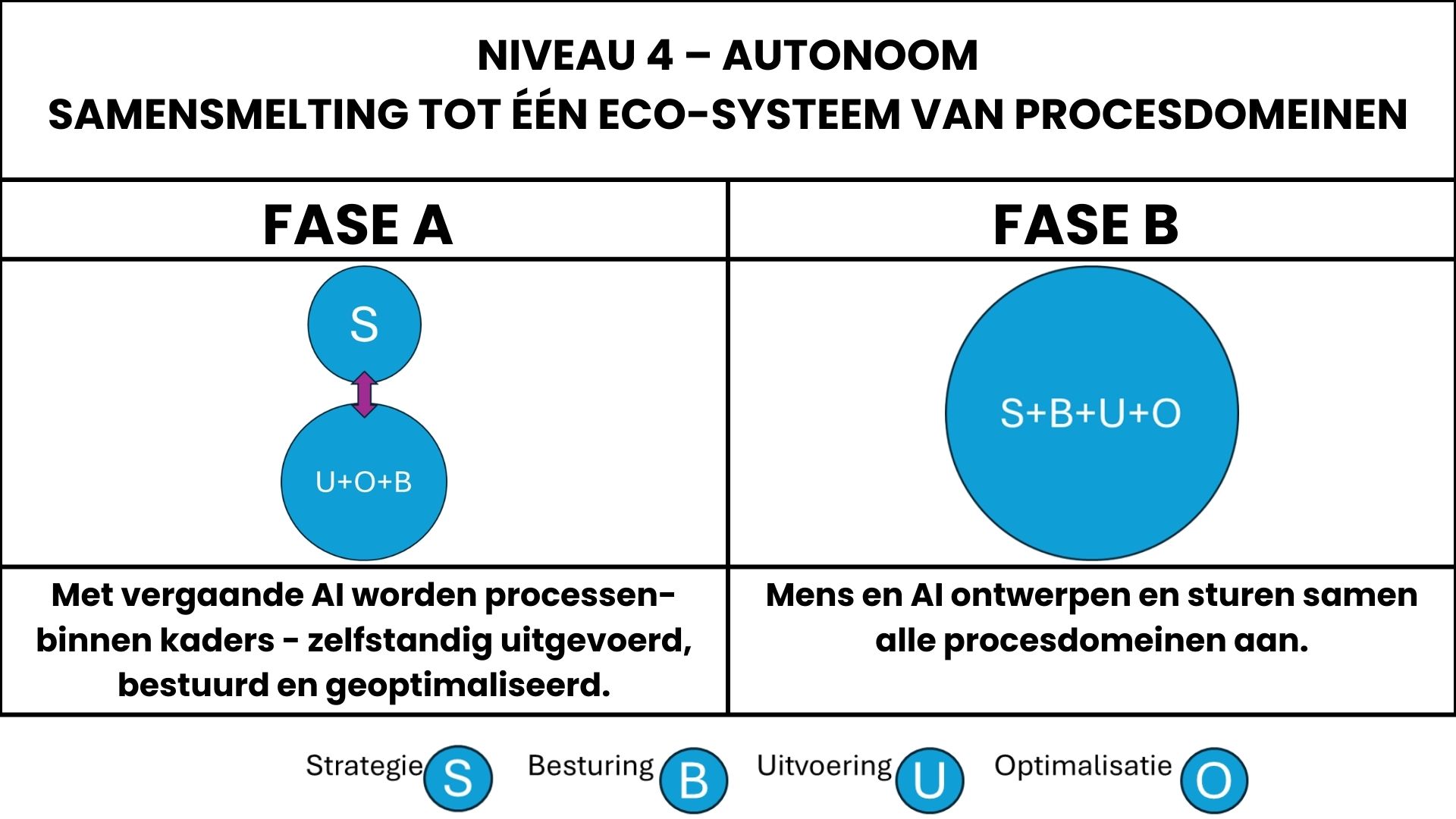
Level 4 - Autonomous and ecosystemic
Merging into one intelligent whole
At the highest level, process domains no longer function as separate layers, but as one coherent ecosystem. Processes steer themselves within explicit frameworks. The role of humans shifts to direction, values and supervision.
Phase 4A - Autonomous litigation
Operational and tactical decisions are made autonomously. AI adjusts processes and optimises continuously. Humans monitor governance, ethics and stability.
Features
- Strategy: set by people
- Control: self-learning
- Implementation: autonomous
- Optimisation: automatic
- Information provision: acting
- AI role: autonomous within frameworks
Core mechanism: autonomy within explicit frameworks
Phase 4B - Strategy as co-creation
Human and AI design strategic options together. Scenarios, simulations and effects are insightful in real time. Strategy emerges continuously and is constantly recalibrated.
Features
- Strategy: co-creation human & AI
- Control: fully integrated
- Implementation: adaptive and autonomous
- Optimisation: strategic
- Information provision: anticipatory
- AI role: co-creating
Core mechanism: joint intelligence
What this means for organisations
This deepening makes one point unmistakably clear:
AI is not a shortcut to mature process management.
AI reinforces what is already there. Only when process thinking, information management and information literacy mature together will there be room for autonomy and fusion.
In the following article, we make this development concrete with different growth paths: In this, AI is not a shortcut to mature process management, but reinforces what is already there. We help you, as an organisation, to determine where you are now in this growth path and show which tools and steps you can use to work specifically on further maturity.

 Services
 Your career
 About us
 Social impact
 Contact
 News
News