























Many publications are currently busy speculating about the impact of AI on the economy and the labour market. For example, an article by Citrini a rather bleak picture: unemployment would rise massively and the economy would collapse completely in a few years. Forbes responds to this a lot more positively, however: while they too foresee a shift in work, they do not share Citrini's pessimistic view.
It is a pattern that occurs with every technological revolution: new technology takes over work, so jobs are lost. But in the past, advances achieved by new technology also created (more) new jobs. How exactly this will play out with AI, we honestly don't know yet. That's a nice topic for macroeconomists.
At the micro level, though, a good assessment can be made. For example, what about the impact of AI on work within the Business Intelligence profession? More can be said about that.
AI and Business Intelligence
Where will the changes in the business intelligence function mainly take place? If the field of work of a business intelligence is subdivided into the phases below, the impact of AI can be estimated for each phase.
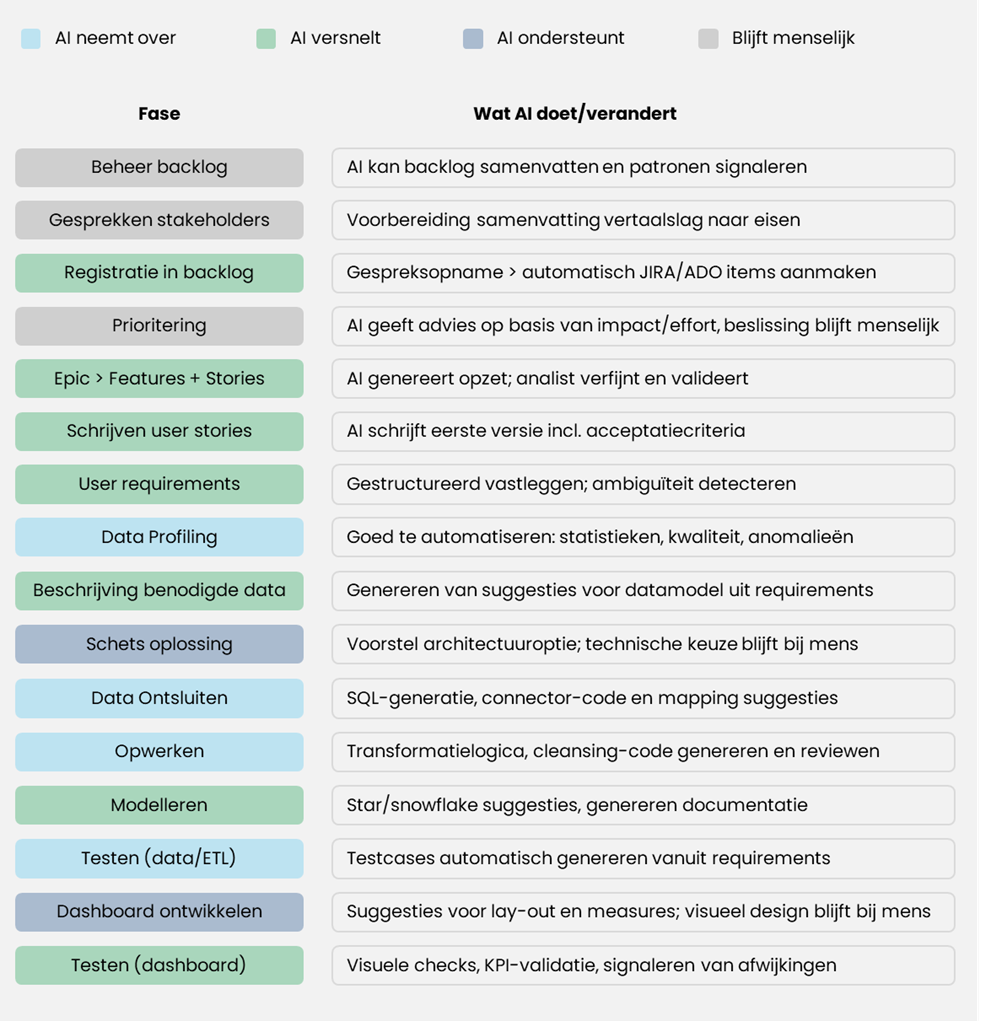
Some of these phases are explained further here.
The strategic front end: backlog, conversations, prioritisation
The phases around backlog management, stakeholder conversations and prioritisation seem at first glance the most human. And of course they are, yet these are not completely immune to the impact of AI. AI can, for instance, convert a transcript of a stakeholder conversation into a structured list of requirements. In relatively simple and well-defined situations, a stakeholder could possibly even formulate what he or she needs in plain language without the intervention of another person (the business analyst). But a real stakeholder conversation is rarely so linear that it could be done without an analyst.
What happens in practice: a stakeholder says what he thinks he wants, the analyst recognises that this does not solve the underlying problem, asks another question, and the conversation tilts towards something no one had thought of beforehand. AI does not yet have the ability to structurally reliably recognise the gap between the requested solution and the real problem. It follows the conversational logic, but does not see through the organisational politics, does not recognise the unspoken agenda, and does not sense when someone says something but means something else.
Furthermore, AI can spot patterns in the backlog that humans overlook and provide prioritisation advice based on historical data. But the decision itself remains a political and organisational consideration that should be left with humans (depending on strategy and interests).
The work at the strategic front therefore changes primarily in character rather than in scope. The business analyst who used to spend an hour typing out interview notes will soon spend that time validating and refining what AI has already prepared. That sounds like a win and it is, but at the same time it places higher demands on the critical ability of that same analyst.
Writing user stories and requirements
This is one of the most direct applications of AI in the BI process and also one of the most underrated. AI can generate a first version of a user story including acceptance criteria, edge cases and data dependencies based on a call recording, an e-mail or a note. What used to be an iterative, time-consuming process of writing, reviewing, consulting and rewriting compresses to: AI writes, humans validate and adjust.
The risk is in the quality of the result. A well-worded user story that describes the wrong question is more dangerous than a messily written story that asks the right question. The analyst deploying AI must have the domain knowledge to recognise when the result is correct. This will not require much less capacity in the future than now.
Data profiling and disclosure
This is where AI is at its strongest. Data profiling is the systematic analysis of the quality, completeness and structure of source data. This is exactly the kind of work where human attention is slack and AI does not get tired. Calculating statistics, detecting outliers, identifying missing values, recognising patterns in data types: the technical side of data profiling can be largely automated, but interpretation remains human work.
The same goes for unlocking data. SQL generation based on a described need, proposing mappings between source and target systems, writing connectors: AI can accelerate and support this, but this still requires intensive validation from the human engineer and it is error-prone in production contexts for now. The engineer is shifting from builder to reviewer and this is a fundamentally different role that also requires a different kind of attention.
Editing, modelling and ETL
The transformation layer is the heart of any data warehouse. It is technical and repetitive enough to be largely generated by AI, but conceptually too complex not to need human guidance. AI can write transformation logic, suggest cleansing rules and build in data quality checks. But choosing, for example, a particular data model (star or snowflake diagram), which granularity or how dimensions are defined is a design decision that requires domain knowledge that is not in the code, but in the mind of the modeller. When it might be technically possible to do this entirely with AI, it is probably organisationally undesirable. Technical possibility and organisational reality are not in the same step.
Testing
Testing is perhaps the phase where AI provides the most immediate and demonstrable added value provided clear definitions and a good test base are in place. Data correctness tests, such as whether the KPI on the dashboard matches the source data in the DWH, can be fully automated. Regression testing after model changes, detecting unexpected deviations, generating test cases from acceptance criteria: this is pre-eminently the domain where manpower still sometimes falls short due to lack of time and AI systematically succeeds.
Dashboard development and acceptance
Building dashboards is changing: AI can suggest a layout based on requirements, suggest measures and recommend colours and visualisation types. But judging whether a dashboard tells the right story to the right audience that is and remains a human judgement. Moreover, acceptance is by definition a human moment: the client must consent, and that consent is not transferable to an algorithm.
Roles are going to change
While the phases in the information product submission process remain largely the same, the relationship between execution and judgement within those phases shifts. AI accounts for a larger share of execution, while the importance of human judgement increases to control AI.
This is a fundamental change for those working in BI today. The junior data engineer who learned his craft by writing a lot of SQL, making a lot of mistakes and understanding those mistakes now gets a shorter and different learning curve with AI. AI delivers a working result faster, but in doing so also compresses the space to learn by doing.
So what is the great added value of humans within work in BI? All work delivered by AI needs to be assessed. And that requires enough subject matter ground to stand on. This is something you don't acquire just by watching AI do it.
Conclusion: What this means for the BI team
Roles will start to shift. A data engineer who today spends 60% of his time manually writing SQL will soon spend that time reviewing, testing and improving AI-generated code. A BI analyst is increasingly becoming a problem owner who instructs and adjusts AI, not someone who does all the computational work himself. This requires different skills: prompt knowledge, critical review of generated output, and domain knowledge to keep AI on track.

 Services
 Career
 About us
 Contact