
























Public-private partnerships have existed for decades to tackle complex societal challenges that no single organisation can address on its own. There are plenty of examples in the fields of infrastructure, energy, mobility and regional development. To carry out such challenges successfully, organisations are increasingly working together to prioritise change initiatives and investments. As a result, the concept of a collaboration portfolio In focus: a framework in which several organisations work together to set priorities, allocate resources and create value. This development is now evident not only in public-private partnerships, but is also increasingly being adopted within the public sector.
From public-private to public-public
Whilst collaboration portfolios were initially found mainly in public-private partnerships, there is a growing need for collaboration within the public sector as well. Challenges such as the energy transition, housing construction, cyber security and healthcare chains require close collaboration between local authorities, implementing organisations, safety regions and ministries. As a result, the focus is shifting from organisational interests to joint outcomes.
This development is part of the broader trend towards network-based management, supply chain collaboration and ecosystem thinking. Collaboration portfolios are therefore expected to play an increasingly important role within the public sector.
How does a collaboration portfolio relate to a chain portfolio?
Although the terms are sometimes used interchangeably, there is an important difference between a chain portfolio and a collaborative portfolio.
- A chain portfolio focuses on a joint task, whilst participating organisations retain their own portfolios, budgets and decision-making processes. The collaboration mainly involves coordination and the management of dependencies.
- A collaborative portfolio goes further. Organisations set priorities, make investments and take decisions jointly, and focus primarily on creating shared value.
The dividing line therefore lies in the degree of integration: as soon as strategic decisions, investments and governance are organised jointly, a supply chain portfolio evolves into a collaborative portfolio.
The evolution from a chain portfolio to a collaborative portfolio
In practice, many supply chain collaborations gradually develop into a portfolio of collaborations. What begins with coordination and an understanding of interdependencies can, as interdependence increases, lead to joint prioritisation, investment and decision-making.
However, not every chain collaboration requires this step. A collaboration portfolio is particularly effective when organisations are heavily dependent on one another and the achievement of objectives requires joint decisions.
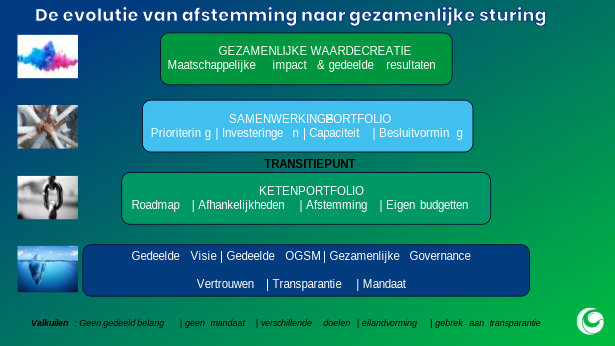
Prerequisites for a collaborative portfolio
Where the aforementioned interdependence applies and the achievement of objectives requires joint decisions, ensure that the following ‘boxes are ticked’:
- A largely shared vision: The participating organisations must agree on the social issue they wish to tackle together. Without a shared vision of the future, disagreements over priorities can quickly arise.
- A largely shared OGSM or strategic framework: Objectives, performance indicators and strategic choices must be sufficiently aligned. A joint OGSM provides a strong foundation for this.
- Joint governance: There must be clarity regarding decision-making, mandate, escalation and ownership. A joint portfolio board is often necessary for this.
- Transparency regarding capacity, budgets and dependencies: Participants must be prepared to provide insight into their roadmap, resources and risks. Otherwise, it will amount to nothing more than a sham collaboration.
- Trust between partners: Ultimately, successful collaboration portfolios are not determined by processes or tools, but by the quality of the relationships between people. Trust forms the basis for shared decision-making.
Pitfalls
At the same time, there are various risks that could hinder the creation of a collaborative portfolio:
- Absence of a shared interest: Acting primarily in the interests of one’s own organisation. When under time pressure, the common interest also comes under strain. The focus then shifts to decision-making based on negotiation rather than joint value creation.
- Governance structure without a mandate: Representatives are unable to take decisions; decision-making is shifted back to the parent organisations, leading to delays.
- Too wide a range of objectives: This leads to ongoing discussions about priorities. Whilst complete uniformity is not necessary, strategic objectives must overlap sufficiently. Where there is no overlap, the matter is addressed within the organisation through the existing governance and portfolio structures.
- Differences in maturity, culture, funding systems, differing cycles and political interests hamper cooperation (joint management versus administrative autonomy). Delays in decision-making and differing paces then become particularly apparent.
Conclusion
The increasing complexity of societal challenges is making organisational boundaries less clearly defined and less significant. Whilst value chain portfolios focus primarily on coordination between organisations, collaboration portfolios offer a model for joint steering. As organisations share more of a common vision, governance and objectives, the distinction between them becomes blurred. The collaborative portfolio thus picks up where chain management leaves off: jointly steering towards value rather than simply working alongside one another.

 Services
 Career
 About us
 Contact