
















In many organisations, I come across the same dilemma: a system that has functioned reliably for years is starting to stifle innovation. The natural reaction is, of course, to replace it.
However, in environments where operations must continue to run 24/7 – such as within logistics chains, distribution centres or healthcare settings – a system migration is much more than just a technical upgrade. It is a complex change in which business continuity, risks and business interests must be constantly weighed up against one another.
In my role as an IT project manager within a complex distribution environment, this soon became clear. The biggest challenge was not in implementing a new system. The real challenge was ensuring that the operational side was affected as little as possible.
At Improven, we use the Digital Compass to examine digital transformation issues from various perspectives. This practical experience demonstrates how technology, organisation and people are interlinked. After all, modernising a system is not just about the technology, but also about how you enable an organisation to change in a controlled manner without losing sight of operational continuity.
The tipping point: thinking in terms of continuity
What has changed my view of IT project management is the realisation that you shouldn’t start with technology, but with continuity.
Not: what could be improved?
But: what needs to keep working?
That may seem like a minor difference, but it has major implications for the choices you make during a project. It forces you to first take a critical look at business processes, dependencies and risks before considering new functionalities or optimisations.
It is precisely this focus that helps to implement changes in a controlled manner without jeopardising day-to-day operations. In practice, this means, for example, that whenever a significant change is proposed, you consider not only what is technically feasible, but also the implications for users, processes and the continuity of operations.
Four insights from real-world experience
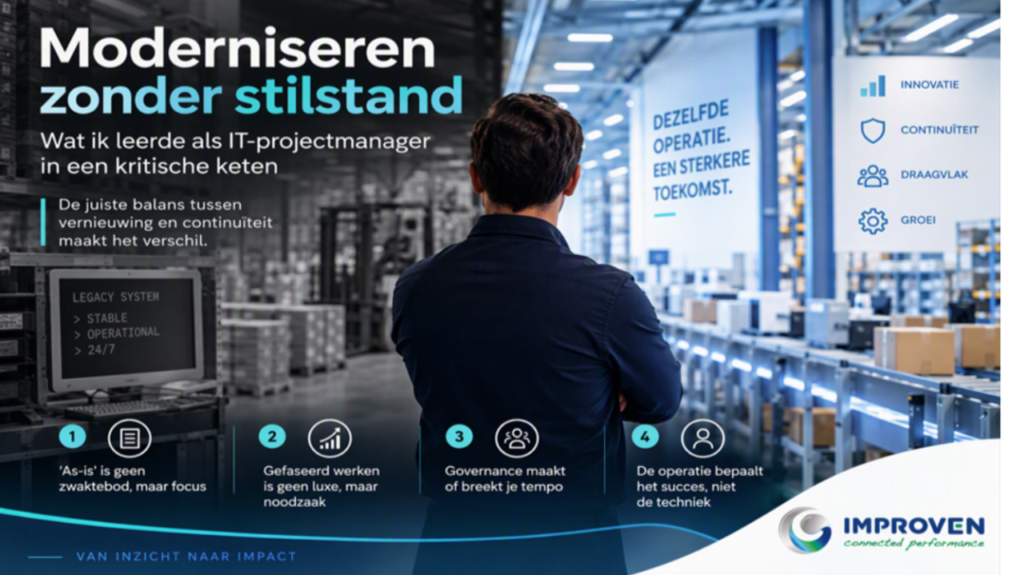
1. ‘As-is’ is not a sign of weakness, but a focus
It is very tempting to combine a migration directly with process improvements and new functionalities. In practice, I find that this often adds extra risk and complexity.
By consciously opting for a functional ‘as-is’ starting point, you create calm, clarity and predictability. You can always optimise things once the new environment is running smoothly. This also gives teams the space to build confidence in the new way of working before the next change is implemented.
2. Working in phases is not a luxury, but a necessity
A ‘big bang’ migration often sounds efficient, but is rarely the wisest choice when it comes to critical processes.
By working with pilot projects, interim milestones and a phased roll-out, you retain control over the implementation. Problems become apparent more quickly and can be resolved before they have a major impact on operations. Each phase therefore not only delivers a result, but also provides new insights for the next step.
3. Governance makes or breaks your pace
In complex projects, it’s all about decision-making.
Unclear responsibilities, a lack of ownership or slow decision-making almost always lead to delays and frustration. Clear governance, well-defined escalation procedures and engaged stakeholders, on the other hand, speed up implementation and make the project more predictable.
In this regard, leadership is at least as important as the structure itself. People need to know who decides what, why decisions are made and what is expected of them. It is precisely this clarity that helps to build support and maintain momentum throughout an implementation process.
4. It is the operation that determines success, not the technique
Although technology is often at the heart of a migration, success is ultimately determined by the people who work with it.
Planners, operators, key users and process owners are the ones who make or break the implementation. In virtually every project, I find that technical challenges can ultimately be resolved. The biggest factor for success remains the extent to which users accept and embrace the new way of working.
This requires more than just communication at the end of a project. Involving users at an early stage, providing opportunities to learn and using feedback to adjust the approach makes the change an integral part of day-to-day work. This not only ensures a successful implementation, but also lays the foundations for continuous improvement.
Why this goes to the heart of IT project management
For me, this is the essence of good IT project management.
It’s not just about planning, scope, budget and progress. Above all, it’s about:
- Bridging the gap between business and IT;
- Managing risks and dependencies;
- Facilitating timely decision-making;
- Building support;
- Maintaining a balance between speed and security;
- Organising learning and improvement both during and after the change.
It is precisely during complex transformations that I see how important it is to have someone who understands both worlds. Someone who can translate the operational requirements into technical choices, whilst at the same time making the impact of technical decisions clear to the business.
That is also where I try to make a difference every day at Improven: helping organisations implement changes in a controlled manner without losing sight of their core business.
In conclusion
I often see organisations start by asking: “What system do we need?”
But the better question is: ”How do we ensure that we can modernise without bringing operations to a standstill?’”
Because implementing technology is one thing. Ensuring that an organisation navigates change safely, in a controlled manner and with confidence – that is where IT project management makes the difference.

 Services
 Career
 About us
 Contact