























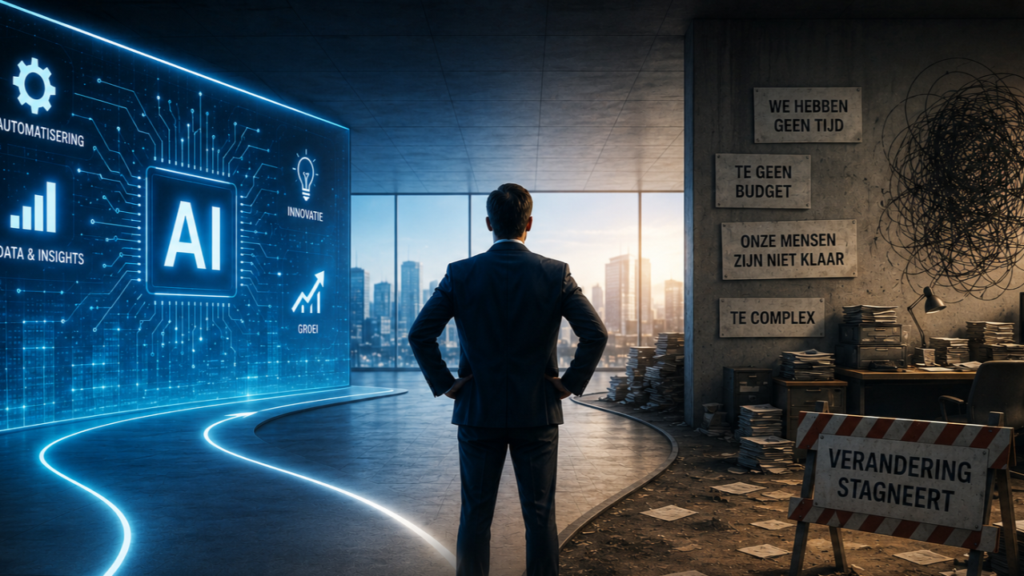
I recently read a article by Koen Wijsman, who argues that AI does not change organisations. The reasoning is that most organisations use AI primarily to work more efficiently. Staff write reports more quickly, carry out analyses in less time and automate routine tasks. Productivity rises and costs fall, but according to the author, the organisation remains essentially the same. The real challenge lies not in the technology, but in leadership, culture and process change.
I agree with a significant part of that analysis. I do not, however, agree with the conclusion.
The observation that many organisations still use AI as a productivity tool is correct. In practice, I see the same thing: Copilot, ChatGPT and similar tools are mainly used for minutes, summaries, analytical work and content creation. This saves time, but does not automatically lead to a different operating model. I also recognise the emphasis on leadership and change management.
Many AI initiatives fail not because of the technology, but due to a lack of ownership, governance, skills and the willingness to genuinely redesign processes. This is in line with broader observations that AI transformation is primarily a human and organisational challenge
With virtually every technological breakthrough, we see the same pattern.
Initially, the technology is used to carry out existing tasks more quickly and cost-effectively. Then the question arises as to whether processes, roles and organisational structures still make sense. It is only in that third phase that genuine transformation takes place. That’s what happened with ERP. That’s what happened with the internet. That’s what happened with the cloud… And it is happening again now with AI.
“Many organisations are still in the initial phase. The focus is on productivity and efficiency. That is understandable. The business case is easy to explain and the results are quickly apparent.”
From automation to redesign
Most discussions about AI focus on saving time. By what percentage can staff work faster? How much capacity can we free up? How much can we save in costs? These are relevant questions, but not the most interesting ones. The fundamental question is:
What does an organisation look like when knowledge is no longer scarce?
For years, organisations have been structured around expertise. Specialists gathered knowledge, managers allocated work, and decision-making took place on the basis of information that was available only to a limited group. AI is changing that fundamental approach. Today, virtually every employee has access to analyses, summaries, scenarios, research findings and specialist knowledge that were previously only available to experienced professionals. This is not only changing the way people work; it is changing the way organisations operate.
Why many AI initiatives get bogged down
At the same time, I can see in practice why many organisations struggle to take the next step. AI is often treated as an IT project. A tool is implemented. Training sessions are organised. People experiment with prompts. Then they expect the transformation to happen automatically. But technology does not change an organisation. People change organisations.
That is precisely why I agree with the observation that leadership and culture are crucial. Organisations that view AI as a technical tool will primarily become more efficient. Organisations that use AI as a catalyst to fundamentally review their way of working will have a much greater impact.
Improven’s vision
At Improven, we therefore take a different approach to AI. We do not see AI as an end in itself, nor as a standalone technology project. We see AI as a catalyst for organisational development and business transformation. For us, the question is not: “How do we implement AI?” However: “How can we create more value for customers, staff and the organisation using AI?”
This calls for a holistic approach that brings together strategy, processes, data, technology, governance and people. After all, real value is not created simply by carrying out an existing or desired process 20% any faster. Real value is created when organisations dare to consider fundamentally different ways of working. Which activities still add value? Which decisions could be made differently? What knowledge do employees still need to possess themselves, and what knowledge can be supported by AI agents?
The organisations that win
I expect two groups of organisations to emerge. The first group uses AI primarily to optimise existing and desired processes. They achieve productivity gains and cost reductions. That is valuable, but limited. The second group will use AI to reshape processes, roles, service delivery and decision-making. This will give rise to new business models, new forms of collaboration and, ultimately, a sustainable competitive advantage. The difference between the two groups lies not in the technology but in their willingness to let go of existing assumptions.
“The difference lies in the willingness to let go of existing assumptions”
The real question
The discussion should therefore not focus on whether AI is changing organisations. That change has already begun! The real question is: Do organisations have the courage to reinvent themselves? Because AI is certainly changing organisations. Not automatically. Not overnight. But, just like previous technological revolutions, its impact will prove to be far greater than the current debate on productivity and efficiency would suggest.

 Services
 Career
 About us
 Contact