























Strategy provides the dot on the horizon, the route to the pot of gold at the end of the rainbow. It gives a company direction and vision for the coming years. Defining this pot of gold often receives ample attention. Heath days, strategy consultants and pizza sessions on your only night off are plentiful. Yet in practice, two-thirds of strategies never get realised¹. This is not because the strategy is bad, but because the organisation is struggling with strategy execution.
Strategy execution prepares the organisation to walk the route, because just the map won't get you there. It is translating, prioritising, steering and tracking the strategic goals. And that is precisely where we see a clear trend. Increasingly More often, a Strategy Realisation Office (SRO) will be set up². Whereas this was relatively new a few years ago, the SRO now seems to be rapidly gaining ground within organisations in transition. The question this article therefore seeks to answer. ‘’Why?’’
From strategy to execution
The explanation lies in a broader shift. Organisations increasingly realise that success is determined not so much by the quality of their strategy, but by their ability to actually execute that strategy. Strategy execution as a competence is thus becoming more central. It is no longer just about formulating ambitions, but about realising them.
Strategy execution is a balance between change (Change) and performance (Run), says strategy execution expert Paul Vervoort³. On the one hand, it is about implementing the strategy. This means that organisations develop new competences, ways of working or propositions needed to achieve the strategic goals. This is often done through programmes, projects and other change initiatives. This is also known as the CHANGE side of strategy execution.
On the other hand, it is about controlling strategy execution. This is about ensuring that the organisation actually functions and performs in line with the chosen course. Think of managing processes and behaviour using management information and control processes. This constitutes the RUN side of strategy execution.
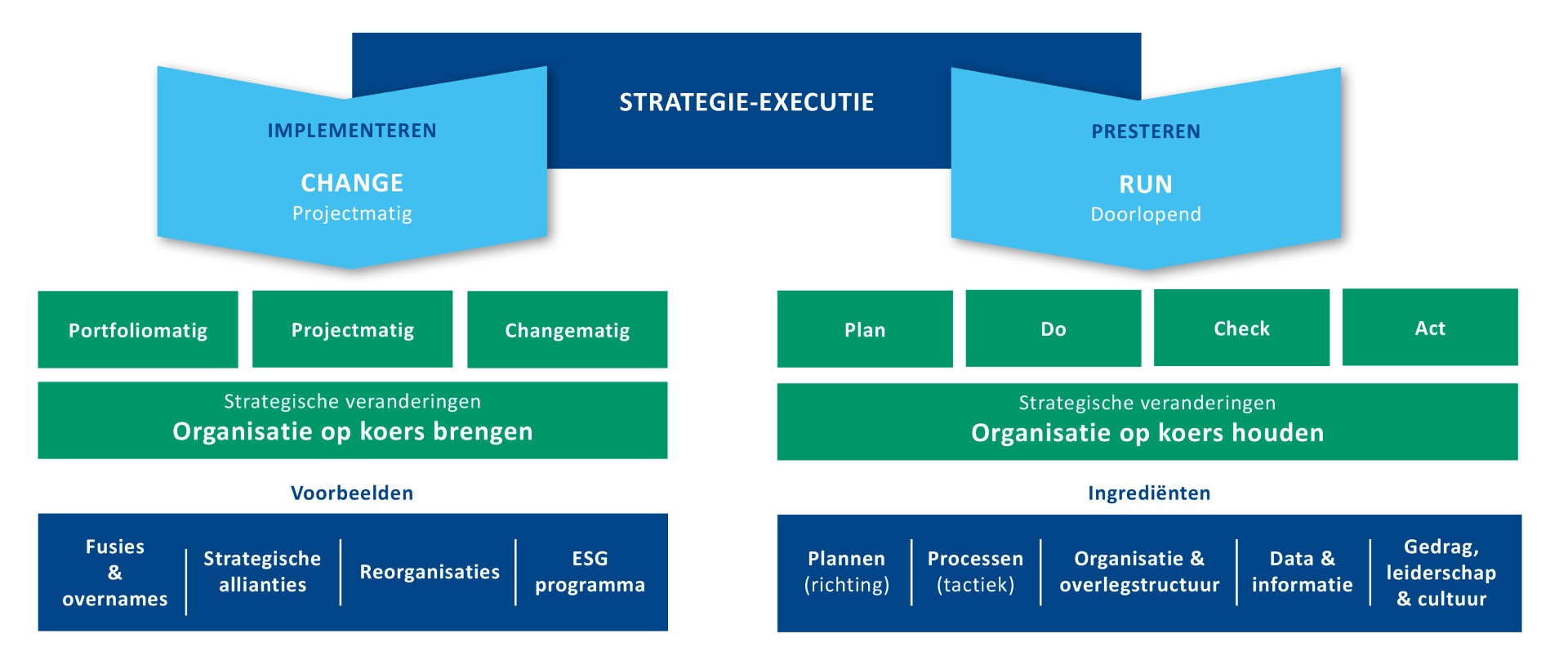
In practice, it appears the biggest challenge therefore in execution lie. Initiatives remain fragmented, priorities shift continuously and progress towards strategic goals has limited visibility.
The need to get a grip on change
The surge in the SRO is no accident. It reflects a growing need for organisations to get a grip on strategic change. Organisations face increasingly complex transformations: new propositions need to be developed, processes redesigned and organisational structures adjusted. This calls for focused management of programmes, projects and transformations, the CHANGE side of strategy execution, which in practice often lacks grip.
As a result, organisations are moving a lot, but making limited progress. This is reminiscent of the difference between ‘Speed & Velocity’, as used in innovation theories. See the figure below. On the left, a lot is happening, but the initiatives are insufficiently connected to the overarching strategy, the direction. Priorities shift, resources are scattered and it remains unclear what initiatives actually contribute to strategic goals.

The emergence of the Strategy Realisation Office is a direct response to this challenge. By providing structure, creating focus and organising coherence between initiatives, an SRO helps make strategic change a reality. An organisations' limited resources can be deployed in harmony in the service of strategic transformation, see right. In doing so, an organisation does fulfil its change mission, which also allows it to function and perform in line with strategy.
An SRO ensures managed strategic change
A Strategy Realisation Office translates strategic ambitions into concrete initiatives.
Strategies usually describe an organisation's direction and ambitions, but often remain abstract. To make a real impact, these ambitions need to be translated into programmes, projects and initiatives. A Strategy Realisation Office helps organisations determine which initiatives are needed to realise strategic goals and which efforts contribute most to them. This creates a clear line from strategic objectives to concrete actions in the organisation.
A Strategy Realisation Office brings focus by helping with prioritisation.
Organisations almost always have more ideas and initiatives than they can implement. Without clear prioritisation, an overcrowded portfolio emerges in which everything seems important. The Strategy Realisation Office supports management in making choices between initiatives so that resources, budget and capacity are focused on the projects that deliver the greatest strategic value. This creates more focus and increases the likelihood of successful strategy execution.
A Strategy Realisation Office creates insight into the progress of strategic goals.
In many organisations, reporting is mainly about the progress of individual projects, for instance in terms of planning, budget and scope. While this is valuable information, it says little about whether the organisation is actually getting closer to its strategic ambitions. A Strategy Realisation Office therefore also focuses on monitoring strategic progress and helps provide insight into the extent to which initiatives contribute to strategy realisation.
A Strategy Realisation Office connects strategic decision-making with day-to-day execution.
Distance can arise between the board that sets strategy and the teams that implement projects. The Strategy Realisation Office acts as a link between these two levels. It helps translate strategic choices into concrete portfolio decisions and, at the same time, ensures that insights from execution are fed back to management. This creates a continuous interaction between strategy and execution, allowing organisations to make better adjustments when necessary.
Conclusion
The rise of the Strategy Realisation Office is a logical consequence of a fundamental shift in how organisations view strategy. It is not the formulation of strategy but the ability to actually realise it that determines success. A Strategy Realisation Office plays a crucial role in this. By translating strategic ambitions into concrete initiatives, setting priorities and creating insight into progress, an SRO ensures that organisations get a grip on strategic change. It ensures that resources, capacity and energy are focused on what really contributes to the strategic goals. This makes the SRO a driving force behind the effective design and steering of the CHANGE side of strategy execution.
At the same time, successful strategy execution is broader than just change. It also requires an organisation capable of performing structurally in line with the chosen strategy: the RUN side. It is precisely the connection between change and performance that determines whether strategy is realised sustainably. Whereas today the SRO is mainly used to get a grip on change, the next step lies in strengthening the connection with the RUN side of the organisation. How do you ensure that strategy is not only implemented, but also permanently embedded in processes, governance, steering and behaviour?
That issue is the focus of a subsequent article.

Want to know how your organisation can improve this? Feel free to get in touch!
Tim Dijkstra is Project & Portfolio Consultant within IMPROVEN with a background in innovation management
Tim Dijkstra¹Harvard Business Review. “Why Strategy Execution Unravels-and What to Do About It.” November 13, 2017.
²Consultancy.co.uk. “10 trends in portfolio- and project management for 2026." January 26, 2026.
³Consultancy.co.uk. “Strategy execution: A balance between change and performance.” January 28, 2025.
 Services
 Career
 About us
 Contact