























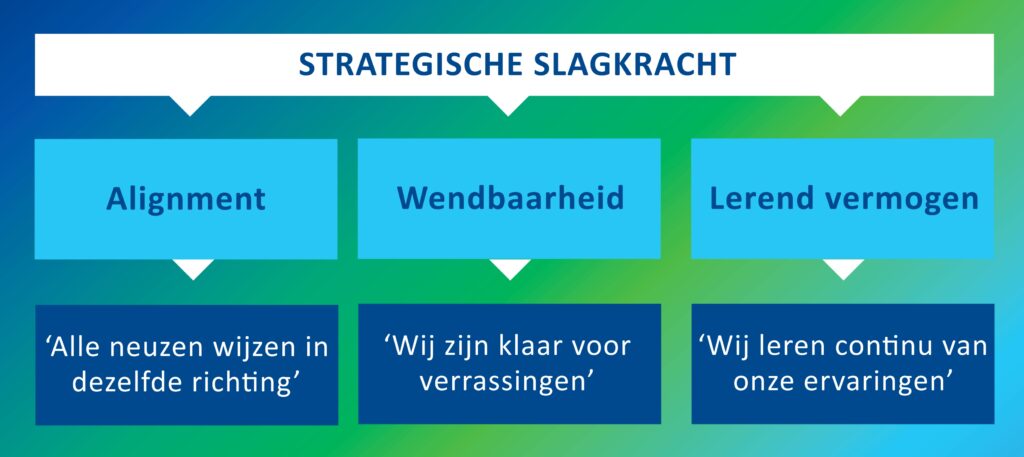
Successful strategy execution appears to be a stumbling block for many organisations, Paul Vervoort stated in the article: The strategy is on track, now it's time to implement it.. Although many companies have their strategy on paper or in their heads, it proves difficult in practice to actually realise these ambitions. The key to success lies not only in formulating a strong strategy, but above all in developing and combining three core qualities: alignment, agility and learning ability. These qualities are indispensable for organisations that want to bring their strategy to life and achieve sustainable results.
Alignment: the basis of effective strategy execution
Alignment: everyone is on the same page. It is about bringing the organisational structure, people, goals, and actions into line with the chosen strategy. When alignment is properly secured, everyone in the organisation knows what the priorities are and works together towards the same goals. This prevents wasting time and resources and ensures that the strategy and the plans that result from it are actually implemented.
Alignment is important in both the short and (medium) long term: it ensures a consistent link between the long and short term, between mission and vision and strategy, and between strategy and tactical and operational plans, summarised in a clear KPI structure.
However, there are two pitfalls when strengthening the alignment of organisations. Alignment is often approached in a top-down manner. This can result in the creation of an island culture: each department has its own KPIs and is not concerned with those of other departments. The solution here is horizontal alignment: focus on cross-departmental collaboration based on process KPIs with maximum customer value as the ultimate goal.
In addition, alignment can lead to inflexibility in the event of unexpected developments. The solution here is to develop the following core quality.
Agility: Being able to deal well with surprises
Agility is an organisation's ability to respond quickly and appropriately to unforeseen external or internal changes. In a world increasingly characterised by volatility, uncertainty and complexity, agility is a must. Agile organisations are resilient and able to seize opportunities in dynamic markets. That is why agility is becoming an increasingly important source of competitive advantage in a turbulent and unpredictable world.
Agility has both short-term and long-term impact: responding immediately to changes can make the difference between success and failure, while lasting flexibility ensures long-term relevance. Practices such as daily stand-ups, short iterations, cross-functional teams and rapid decision-making are characteristic of agile organisations. This does not have to stand in the way of a long-term vision; on the contrary, it ensures that the organisation remains fit during the journey. The biggest challenge lies in breaking old habits and structures and finding a good balance between autonomy and central control. Too much change can also lead to change fatigue, something we regularly encounter as a consultancy firm within client organisations. This shows how important it is to develop and maintain agility in a purposeful and measured way as an organisation.
Learning ability: a crucial skill in the long term
An organisation's ability to continuously improve and apply new knowledge, or in other words: learning capacity. It is the driving force behind renewal and innovation. Organisations that learn faster and better than their competitors build up a lead that translates into higher quality, more innovation and ultimately better financial performance. Learning is a cumulative process: what is learned today leads to new insights and better methods next year, and only the year after that to clearly improved financial results. Practices such as knowledge-sharing sessions, appropriate training and encouraging a ‘make mistakes quickly and learn from them even faster’ mentality contribute to a strong learning culture. Embedding learning in daily practice requires an environment of safety and openness. Employees must dare to share mistakes and celebrate successes, so that the effect of learning becomes demonstrable and commitment is maintained. The challenge is to ensure that learning is not overshadowed by the hustle and bustle of the day, but is structurally embedded in both processes and culture.
How the three core qualities reinforce each other
The core qualities are not separate from each other, but work together. Alignment is conditional: without proper coordination, it is unclear to what extent the organisation needs to be agile, and the organisation's employees do not have a clear understanding of the desired learning direction. Learning ability strengthens both alignment and agility, because it provides insight into how coordination and flexibility can be improved. Agility, in turn, requires alignment to be effective and is easier to achieve in a learning culture where people are open to new approaches. Together, good alignment, agility and learning ability form a strong whole that enables organisations to not only create strategy on paper, but also bring it to life in practice.
Although the CEO is not exactly uncontroversial, we consider Tesla to be a strong example. The thinking and actions of the entire organisation are dominated by its mission: “to accelerate the world's transition to sustainable energy”. The mission is not just a slogan; it is powerfully and uniquely promoted and lived by Tesla's leader, and forms the guiding principle for all decisions and innovations. Impact reports show how this mission is reflected in products (EVs, batteries, solar panels) and the supply chain: everything is focused on sustainability and scalability.
And while traditional car manufacturers shut down factories after the post-coronavirus shortages, Tesla rewrote its software to use alternative chips. This demonstrates extreme agility in supply chain and engineering.
Tesla's organisational culture encourages employees to “do the impossible” and to reason from ‘first principles’ such as move fast and we are all in. This promotes continuous learning and problem-solving skills.
In the next article, we will tell you more about how we help organisations consciously develop these core qualities using four building blocks: Direction, Structure, Control and Behaviour.


 Services
 Career
 About us
 Contact