























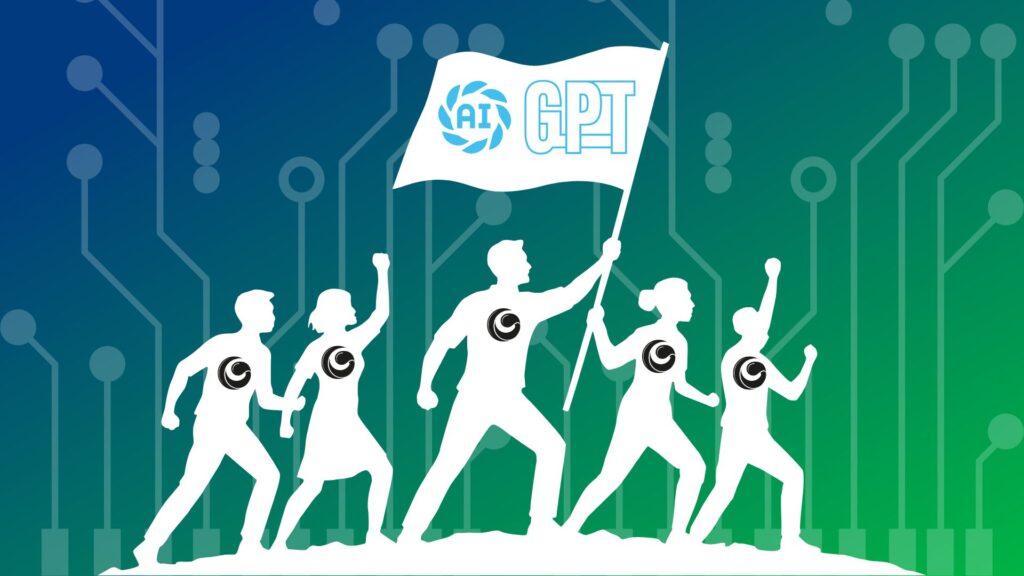
At first glance, digital transformation and generative artificial intelligence appear to be two separate processes, but they actually reinforce each other. According to McKinsey, digital transformation is the „fundamental rewiring” of an organisation with the aim of creating value by continuously deploying technology at scale.[1]. That is a long journey, not a one-off project; most managers will be engaged in it for the rest of their careers.[2]. At the same time, in August 2025, OpenAI introduced GPT-5, a model that delivers state-of-the-art performance in areas such as coding, writing, and health.[3]. The model combines an efficient baseline, a deeper thinking model and a real-time router that automatically selects the right profile.[4]. Because GPT-5 is faster, better, and more reliable than previous generations.[5], The question is how this technology can accelerate the digital transformation of organisations.
What is digital transformation?
McKinsey defines digital transformation as the complete redesign of how an organisation operates in order to continuously deploy technology at scale for a better customer experience and lower costs[1]. Unlike traditional change processes, a digital transformation does not stop once a new way of working has been introduced; technology continues to evolve, requiring companies to constantly adapt.[2]. This explains why approximately 90% of organisations are engaged in some form of digital transformation.[6].
Successful digital transformation requires a coherent set of capabilities[7]:
- Clear strategy: a roadmap focused on business value and priority areas such as customer journeys or processes[8].
- Talent development: a strong internal talent bench with digital and AI experts who work closely with business colleagues[9].
- Scalable operating model: cross-functional teams and a model that supports hundreds of teams[10].
- Distributed technology: Technology should enable teams to innovate independently through APIs, cloud migration, and automated infrastructure.[11].
- Accessible data: reliable and up-to-date data with good governance[12].
- Adoption and change management: at least as much attention to training and process adaptation as to the technology itself[13].
These building blocks are necessary for digital and AI applications to generate value; technology alone does not create value.[14].
GPT-5: the new standard in generative AI
GPT-5 is OpenAI's flagship model for text and vision tasks. The system combines a base model, a ‘thinking’ variant for deeper reasoning, and a router that automatically switches between these profiles.[4]. The main improvements are:
- Better performance and fewer hallucinations: GPT-5 follows instructions more accurately, producing 45 fewer factual errors than GPT-4o and 80 fewer errors than the earlier model ‘o3’ when reasoning more deeply.[15]. ChatGPT is designed to think more deeply when necessary.[16].
- Stronger in coding: GPT‑5 generates responsive front-end applications and debugs large codebases, with a focus on design and user experience.[17]. For developers, this results in usable code and better layouts.[18].
- Multimodal: the model performs better on benchmarks for visual, spatial and scientific reasoning[19]. This enables it to interpret images, diagrams or videos and integrate them into answers.
- Agentic tool use: GPT-5 can better follow instructions and coordinate different tools to perform more complex tasks.[20]. It supports longer contexts (up to 400 k tokens) and can combine multiple API calls within a single workflow.[21].
- Economic value: In internal benchmarks, GPT-5 performs at or above the level of experts for tasks in over 40 professions, including law, logistics, sales, and engineering.[22].
- Safety and fairness: the model provides more honest answers and communicates better when a task is impossible[23]. Auto-routing and safe completions provide reliable advice and are particularly helpful in enterprise contexts.[24].
In addition to the main model, OpenAI also offers smaller open-source variants, such as gpt-oss-20B and gpt-oss-120B, which run locally or on edge devices. This allows organisations to use similar instruction sets and tools without sending all data to the cloud.
Revolutionary synergy: GPT‑5 as the engine for digital transformation
Digital transformation revolves around developing strategy, talent, technology, and data. GPT-5 can accelerate all of these dimensions. The synergy between the two arises in various ways:
Faster software development and innovation
GPT‑5 is one of the most powerful coding models. It generates front-ends, API integrations and games with minimal input.[17]. For digital transformation, this means that internal development teams can build prototypes faster, refactor legacy code, and write better documentation.[26]. According to Okoone, the biggest improvements in GPT-5 are in code generation, multimodal support, and coordinating multiple tools.[26], enabling organisations to automate repetitive tasks and iterate more quickly.
Personal customer interaction and content creation
GPT-5 delivers natural, expressive texts for emails, reports or marketing content and recognises context, tone of voice and target audience.[3]. Furthermore, it can utilise multimodal input, enabling customer service or sales departments to analyse photographs or diagrams to answer queries.[19]. The large context windows make it easier to manage long conversations and files, which benefits personalisation and consistency.
Advanced data analysis and decision-making
GPT-5 offers better reasoning and is less prone to ‘hallucination’, making it more suitable for critical analytical work.[15]. Forbes emphasises that GPT-5 combines auto-routing and secure responses, making the model a reliable everyday partner.[24]. In management reports, it can summarise complex data and generate scenarios; in finance and law, it acts as an advisor that combines information from various sources.[5]. Forward Dynamics describes how Microsoft's integration of GPT-5 into Dynamics 365 automates financial forecasting, improves decision-making in Business Central, and provides contextual recommendations in Outlook or Teams.[27].
Workflow automation and tool orchestration
Organisations pursuing digital transformation want to streamline processes. GPT‑5 can control multiple tools and combine API calls within a single session.[21]. In Microsoft's Power Platform, this leads to low-code development, automated workflows, and smart dashboards.[28]. Within ERP and CRM systems, GPT-5 automates data entry, reconciliation, reporting, and customer interactions.[29], allowing employees to focus on valuable analysis rather than routine tasks.
Training, knowledge transfer and talent development
Generative AI makes training scalable. Employees receive on-demand explanations, code examples, or customer cases. McKinsey's research shows that 91 per cent of respondents use gen-AI tools for work and that many employees expect these tools to improve creativity and critical thinking.[30]. By utilising GPT-5 as a knowledge partner, organisations can develop talent more quickly, a crucial element for successful transformation.[9].
Cost savings and scalability
OpenAI has structured the pricing of GPT-5 in such a way that input tokens are cheaper than in previous models.[31]. With smaller variants (mini and nano), functionality can be tailored to budget and performance.[32]. Mindbees points out that improved efficiency and cost flexibility make GPT-5 a productivity driver.[33]. This is important for organisations implementing large-scale transformation programmes: they can deploy the technology widely without costs spiralling out of control.
Critical view and preconditions
Although GPT-5 is impressive, organisations must remain realistic. Okoone emphasises that GPT-5 is not autonomous AGI and does not make strategic decisions independently; the model remains dependent on human context, governance and infrastructure.[34]. True agentic AI requires secure data access, identity and access management, and integrated software stacks, prerequisites that are still lacking in many companies.[35]. According to McKinsey, generative AI is only valuable when it is part of a broad organisational process with clear business cases.[14] and the use of AI is linked to measurable objectives[36].
Implementation must also be carried out carefully. Forbes advises leaders to:
- Hybridising the organisation – Combining different models (GPT-5, mini, open-source) to meet diverse needs[37].
- Utilising optimisation routing, but to monitor failures and apply fine-tuning where necessary[37].
- Measuring KPIs such as time to code fix, resolution of support tickets, and quality of content[37].
- Relationship with the OpenAI ecosystem to build for both consumer and enterprise tools[37].
- Time to redefine – AI capacity is growing rapidly; organisations must accelerate their pace to keep up[37].
Implications for Improven
As a consultancy firm that helps organisations improve, Improven can integrate GPT-5 into its digital transformation processes. A number of possibilities:
- Analysis and process design: Use GPT-5 to quickly generate process descriptions, reports, and improvement proposals; combine text with visual data to persuade stakeholders.
- Software acceleration: For system migrations or low-code development projects, GPT-5 can generate code and user interfaces, shortening development cycles and improving quality.[17].
- Improving customer experience: Implement GPT-5-powered chatbots or personal assistants in customer portals to answer questions faster and deliver relevant information. Thanks to multimodal input, the bot can also analyse images and provide feedback.[19].
- Change management and training: Use GPT-5 as a virtual coach to guide employees through new tools and processes. By simulating best-practice scenarios, teams can accept changes more quickly.
- Governance and ethics: Develop guidelines for the use of generative AI, including data management, security and transparency, in collaboration with customers. This is in line with the need to strengthen infrastructure and governance.[35].
Conclusion
Digital transformation requires a holistic approach and continuous adoption of technology.[2]. GPT-5 delivers a powerful new engine: it combines improved reasoning, better error reduction, expanded context windows, and advanced tool orchestration.[4][20]. These qualities accelerate software development, personalise customer contact, enhance data analysis and automate workflows. At the same time, GPT-5 is not a panacea; it requires a clear strategy, trained teams and solid infrastructure.[34]. For Improven BV, this presents opportunities to help customers integrate generative AI into transformation programmes, thereby increasing both efficiency and innovation. By combining GPT-5 and digital transformation, a revolution is taking place that is making organisations more agile and future-proof.

For more questions or information on this topic Maliki Fofana
[1] [2] [6] [7] [8] [9] [10] [11] [12] [13] What is digital transformation? | McKinsey
https://www.mckinsey.com/featured-insights/mckinsey-explainers/what-is-digital-transformation
[3] [4] [15] [17] [19] [20] [22] [23] Introducing GPT-5 | OpenAI
https://openai.com/index/introducing-gpt-5/
[5] [16] [18] GPT-5 is here | OpenAI
[14] [30] [36] Gen AI adoption: The next inflection point | McKinsey
[21] [26] [31] [34] [35] GPT-5 has just arrived, but agentic AI is still stuck in first gear | Okoone
[24] [25] [37] OpenAI’s GPT-5 Launch Pushes Every Business Into AI Time
[27] [28] [29] Why Microsoft’s GPT-5 Integration Makes 2025 the Year of Smarter Business Software | Forward Dynamics Solutions
[32] [33] What OpenAI’s GPT-5 Means for Businesses in 2025
https://www.mindbees.com/blog/openai-gpt5-features-updates-business-2025/
 Services
 Career
 About us
 Contact