























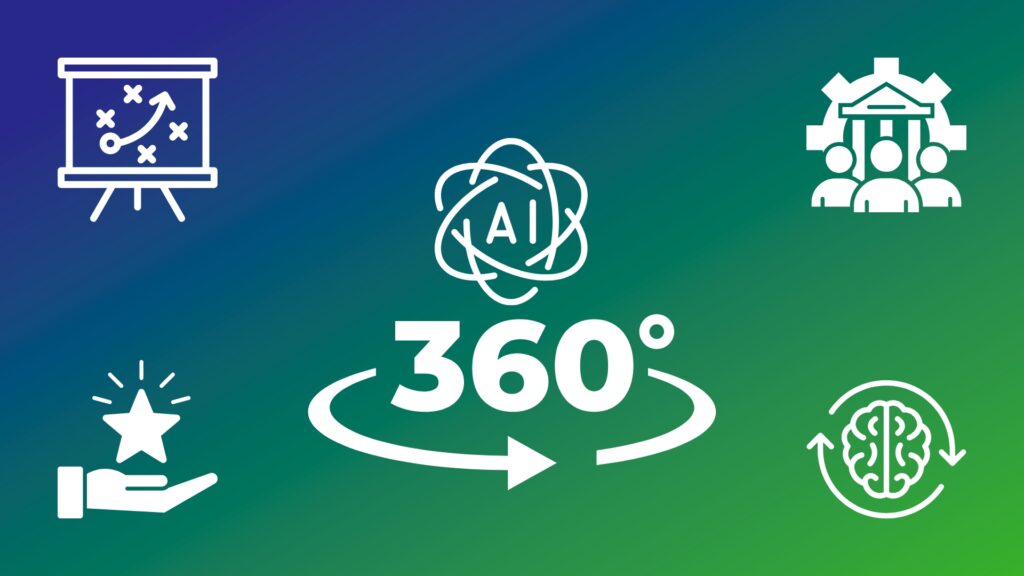
AI only delivers sustainable value when organisations look beyond productivity gains and also integrate strategy, governance, financial value and behavioural change. Michel Hoeijmans of Improven explains how organisations can approach AI from these four perspectives.
I recently spoke to a project manager who enthusiastically explained just how much time he’s now saving thanks to AI. Meeting minutes that used to take two hours to produce are now available within a few minutes. Risks are identified more quickly from documents, and progress reports can largely be prepared using Copilot. A great result. Exactly the sort of productivity gains that many organisations are currently looking for.
Nevertheless, I asked him another question: “What do you do with the time you save?” There was a brief silence. That moment is illustrative of the phase many organisations find themselves in. We’re gaining a better and better understanding of what AI is technically capable of, but we’re still not giving enough thought to what AI actually changes: in processes, in decision-making, in management and in collaboration between people.
AI helps us to carry out existing tasks more quickly. That is valuable, but it does not yet constitute a transformation. The real change only begins when we ask ourselves whether we should still be organising our work in the same way.
Virtually every organisation is now experimenting with generative AI, Copilot or AI agents. The initial applications are often practical and straightforward. AI helps with writing texts, carrying out analyses, summarising meetings and automating routine tasks. This quickly generates enthusiasm. A pilot demonstrates that the technology works and staff experience immediate benefits.
But following those initial successes, the more difficult questions arise: Which AI applications genuinely contribute to our strategy, what happens to costs when we scale up, which processes do we need to redesign, and what does this mean for roles, responsibilities and leadership?
“Saving time is not the same as transformation.”
AI is then no longer simply a tool that can be implemented by IT. It becomes an organisational issue that touches on strategy, data, finance, governance, processes, leadership and behaviour. It is precisely in this area that, in practice, we see many AI initiatives stalling. Not because the technology doesn’t work, but because the rest of the organisation is not yet prepared for its possibilities and consequences.
Four perspectives that, together, make all the difference
At Improven, we are convinced that AI only adds sustainable value when organisations examine the issue from all relevant perspectives.
Strategy: Where does AI create value?
Not every possible AI application is necessarily a sensible investment. Organisations need to determine where AI actually contributes to better service delivery, more efficient processes, higher quality or new revenue opportunities. Without clear priorities, a disjointed collection of pilot projects can quickly emerge.
Governance: Who is in charge?
Organisations need to know which AI applications are being used, what data they are working with, and who is responsible for the outcomes. This requires agreements on ownership, privacy, security, transparency and human oversight. Data quality is crucial in this regard. AI accelerates what already exists. If the underlying data is incomplete or unreliable, AI will primarily exacerbate existing problems.
Value: What demonstrable benefits does AI deliver?
AI entails different cost structures to traditional IT. Costs may depend on user volume, tokens, models, computing power and the number of actions an AI agent performs independently. An application that appears affordable in a small-scale pilot may become considerably more expensive when scaled up. Organisations must therefore determine in advance what results they expect, how they will measure those results, and when they will decide to scale up, adapt or discontinue an application.
Behaviour: How are work and leadership changing?
AI is changing not only what staff do, but also how they think, collaborate and make decisions. Managers must allow scope for experimentation, whilst at the same time setting clear boundaries. Staff must learn when they can trust AI and when professional judgement remains essential.
A single, integrated approach from Improven, It’s Value and TLAB
A 360-degree perspective requires a range of specialist skills working together from the outset. At Improven, we integrate AI with strategy, processes, data, governance and implementation. We help organisations to identify promising applications, draw up a realistic roadmap and embed AI responsibly within their business operations.
“Technology can be installed. New behaviour doesn’t emerge at the touch of a button.”
At It’s Value, we focus on the economic side of things. What does AI actually cost? Which investments deliver demonstrable value? How do we set up financial governance? And how do we determine which initiatives should be scaled up, optimised or discontinued?
At TLAB, we focus on leadership, teams and organisational development. What changes does AI require of managers? How do we get staff on board? What behaviour is needed to use AI responsibly? And how do we build an organisation that can continue to adapt as the technology evolves?
These are not three separate issues, nor are they three distinct services. They are three perspectives on the same change. It is precisely this interconnection that determines the outcome.
A comprehensive approach to AI
Many organisations have now reached the experimental phase. The challenge now is to make the transition from individual applications to a coherent and manageable development process. This does not mean that an organisation has to launch a large-scale AI programme straight away.
The first step is often simpler: working together to assess where the organisation currently stands, which applications are already in use, where the greatest value lies, and which risks are not being adequately managed.
At Improven, we bring together the expertise of Improven, It’s Value and TLAB to achieve this. Not because AI requires more consultants, but because the issue is too important to be approached from the perspective of just one discipline. Strategy, value, governance and behavioural change must be linked from the outset.

 Services
 Career
 About us
 Contact