























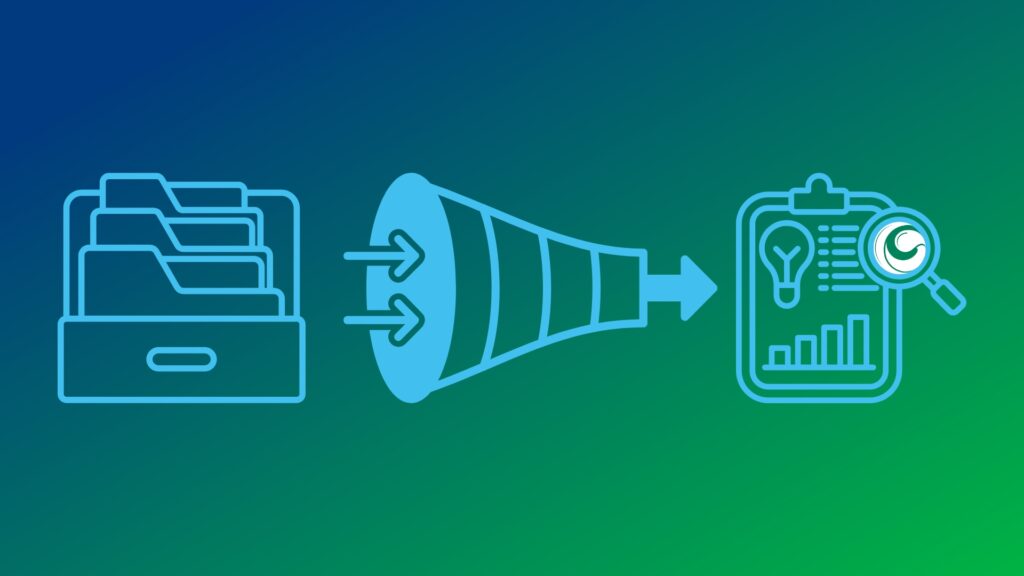
There is often a perception within organisations that developing a report or dashboard is a relatively easy job. The question often sounds logical, understandable and innocuous: “The data is already there, isn't it? Can't you just make a dashboard out of that?”
Anyone who deals with Business Intelligence on a daily basis knows that the reality is considerably more complex. Between an initial information request and a reliable dashboard suitable for production, there is an intensive process that brings together analysis, technology, tuning and governance. Want to know more about this process? In this article, we explain what is involved in producing information products.
It doesn't start with data, but with understanding
A good BI project does not start with building visualisations, but with understanding the real information needs. What exactly does the business want to know? What decisions need to be supported? And perhaps more importantly: what exactly do they mean by terms like lead, project, region or order?
In practice, definitions rarely appear to be unambiguously defined. Departments use different interpretations of the same data. Processes have grown historically and are not always designed uniformly. Focusing on requirements therefore requires a lot of talking, questioning and validation. A so-called ‘proof of concept’ is regularly developed in this phase, sometimes directly on the source systems, to test assumptions. This is often when the first data quality issues arise and when it becomes clear that clear and unambiguous definitions are lacking.
The search under the bonnet
Once it is clear what insights are needed, the technical exploration begins. Which systems contain the relevant data? How are these recorded? Are fields filled consistently? What is the origin of the data and what operations have already taken place?
In larger organisations, knowledge about applications and data sources tends to be dispersed. The business knows the process, the functional manager understands the layout of the system and the data engineer knows how data is accessed technically. Bringing these perspectives together requires consultation and clear direction. Without that joint effort, there is a risk that a dashboard will appear technically correct, but will not match reality in terms of content.
The foundation: unlocking and structuring
Before a dashboard can be built, the data must be made technically available within the data platform. In modern environments, this is often done according to the medallion architecture: raw data in the bronze layer, cleaned and validated data in the silver layer and business-oriented datasets in the gold layer.
This layered approach ensures control, traceability and quality, but also requires design choices and discipline. Data is not simply copied; it is checked, enriched and structured. This phase often reveals hidden problems: missing values, inconsistent coding or historical contamination. Solving these affects not only the BI team, but also process owners and application management. BI thus regularly acts as a catalyst for broader process improvement.
From data to information
Once the data is technically in order, the next step is modelling. This is where it is determined how facts and dimensions relate to each other and how business logic is applied. A good data model ensures that definitions are used consistently and that reports remain scalable as the organisation grows.
Only then comes the visible part: the dashboard itself, developed for example in Microsoft Power BI or Tableau. At that point, it seems like the work is just beginning, when in reality most of the effort has already taken place behind the scenes. The trick is to translate complex data into clear insights, without losing nuance or provoking wrong conclusions.
The organisation factor
Besides content and technical complexity, the organisational context also plays a major role. The larger the organisation, the more responsibilities are distributed. Stakeholders have different interests, priorities and perspectives. Decision-making takes time and new insights can lead to revision of previous choices.
It is therefore not unusual for the development of a robust dashboard - from initial demand to production - to take months. This is not a sign of inefficiency, but of diligence. It is expected that the integration of AI and BI will significantly reduce the overall lead time, though.
From “equally quick” to structural value
The idea that a dashboard is just a visual representation of existing data does not do justice to the field. Business Intelligence requires analytical ability, technical expertise and strong cooperation between business and IT. The business can also certainly play a role in shortening the lead time of dashboard development: for example, by freeing up enough time for the (sometimes) difficult questions of the business analyst, thinking carefully about the actual information needs and understanding the (usually) Agile production process within the Business Intelligence team.
When this process is set up properly, it creates more than just a report. It creates a reliable steering tool that supports decision-making, increases transparency and contributes to strategic growth.
A dashboard is thus not an end product, but the result of a carefully constructed foundation. And that very foundation ultimately determines the value that Business Intelligence adds to the organisation.
Improven's consultants have extensive experience with Business Intelligence issues. They are eminently strong in fulfilling the role between business and IT.

 Services
 Career
 About us
 Contact